


TL;DR:
- World lullabies are traditional songs from diverse cultures that soothe infants and promote early development. These songs, regardless of language, help children relax, learn new sounds, and build empathy through repeated exposure and caregiver involvement. Effective programs feature live music, skilled teachers, authentic repertoire, and active caregiver coaching to maximize developmental benefits.
World lullabies are traditional soothing songs passed down through generations across every culture on earth, and they belong in your child’s earliest musical experiences. When you bring these songs into a music class setting, something genuinely remarkable happens: infants calm, caregivers connect, and children begin absorbing the rhythms and sounds of a wider world before they can even speak. Research from Harvard’s Music Lab confirms that lullabies relax infants regardless of the language they’re sung in, pointing to universal acoustic qualities that transcend cultural boundaries. Programs like Allisongs for Tots in Tampa have built their entire curriculum around this insight, weaving multicultural lullabies into every session for children from birth through age five.
Here is what makes world lullabies so powerful in early childhood music classes:
- They expose infants and toddlers to diverse rhythms, tonal patterns, and melodic structures that enrich brain development.
- They give caregivers a shared musical language to use at home, extending learning well beyond the classroom.
- They build cultural curiosity and empathy from the very first months of life.
- They support language acquisition by introducing new phonemes and prosodic patterns.
- They create calm, predictable transitions that help young children regulate emotions.
How world lullabies support your child’s development
The benefits of international lullabies go well beyond a good night’s sleep. Experts recommend selecting culturally diverse songs over repetitive children’s tunes precisely because new stimuli encode more richly in a developing brain. A Japanese komoriuta, a West African lullaby, or a Spanish nana each carries distinct melodic contours that challenge and strengthen auditory processing in ways that “Wheels on the Bus” simply cannot.
- Language acquisition: Exposure to varied phonemes and rhythmic patterns primes infants for multilingual sensitivity and stronger early literacy.
- Emotional regulation: The slow, repetitive structure common to lullabies from around the world helps children self-soothe and transition between states of arousal.
- Cultural identity and inclusivity: Children who hear music from many traditions develop broader empathy and a more open sense of who belongs in their world.
- Caregiver-child bonding: Singing together during class, and then again at bedtime, deepens parent-child attachment in measurable ways.
- Prosocial skills: Group music experiences with diverse repertoire teach turn-taking, listening, and cooperation.
Research note: NPR’s reporting on lullaby science found that toddlers fell asleep 35% faster with music at naptime, and preschoolers 19% faster, according to University of Miami researcher Tiffany Field.
What makes an effective music class featuring world lullabies
Not every children’s music class delivers the same results. The difference between a class that genuinely supports development and one that simply entertains comes down to a few specific qualities.
Live, interactive music is significantly more effective than prerecorded songs because a skilled teacher can adjust tempo, volume, and key in real time to match a child’s emotional state. That responsiveness is impossible with a playlist.
- Trained teachers: Look for educators who combine music training with early childhood development expertise. Musical proficiency alone does not guarantee meaningful infant engagement.
- Simple, repetitive melodies: Effective classes use songs with clear, predictable structures that young children can anticipate and eventually join.
- Multi-sensory engagement: Safe instruments, movement, and tactile props support the one-thing-at-a-time approach that aligns with how toddlers actually process new input.
- Predictable structure: Hello songs, active movement segments, lap songs, and goodbye rituals give children the security to engage fully.
- Caregiver coaching: The best classes treat parents as primary learners, teaching them how to use music meaningfully at home.
Pro Tip: Ask any prospective class whether the teacher follows the children’s energy or a rigid script. The most effective teachers respond dynamically to a child’s cues, slowing down when a baby needs calm and picking up energy when the group is ready to move.
How to choose a multicultural music class for your child
Choosing the right program takes more than a quick Google search. Here are the criteria worth prioritizing:
- Teacher qualifications: Seek educators with credentials in both music education and early childhood development, not one or the other.
- Live music practice: Confirm that teachers sing and play instruments live in every session, not just press play on a speaker.
- Cultural authenticity: Ask whether the multicultural repertoire is authentically arranged and respectfully presented, not simply novelty songs with foreign-sounding names. Culturally relevant songs arranged with care make a real difference in what children absorb.
- Research-informed curriculum: Programs grounded in attachment theory and developmental science produce better outcomes than those built around entertainment alone.
- Caregiver participation: Classes where parents sing, move, and interact alongside their children produce earlier neurological and social responses in babies.
- Class size: Smaller groups allow teachers to respond to individual children and give caregivers more direct coaching.
For families in Florida, Allisongs for Tots checks every one of these boxes. Music educators managing diverse rosters can also find useful administrative guidance through student roster management resources designed specifically for early childhood programs.
Allisongs for Tots: multicultural music classes in Tampa
Allisongs for Tots has spent over 15 years building a curriculum that puts cultural diversity and caregiver involvement at the center of every session. Director Allison Wilkins combines lullabies from around the world with original songs she has composed specifically for young children, creating a repertoire that is both globally informed and locally beloved.
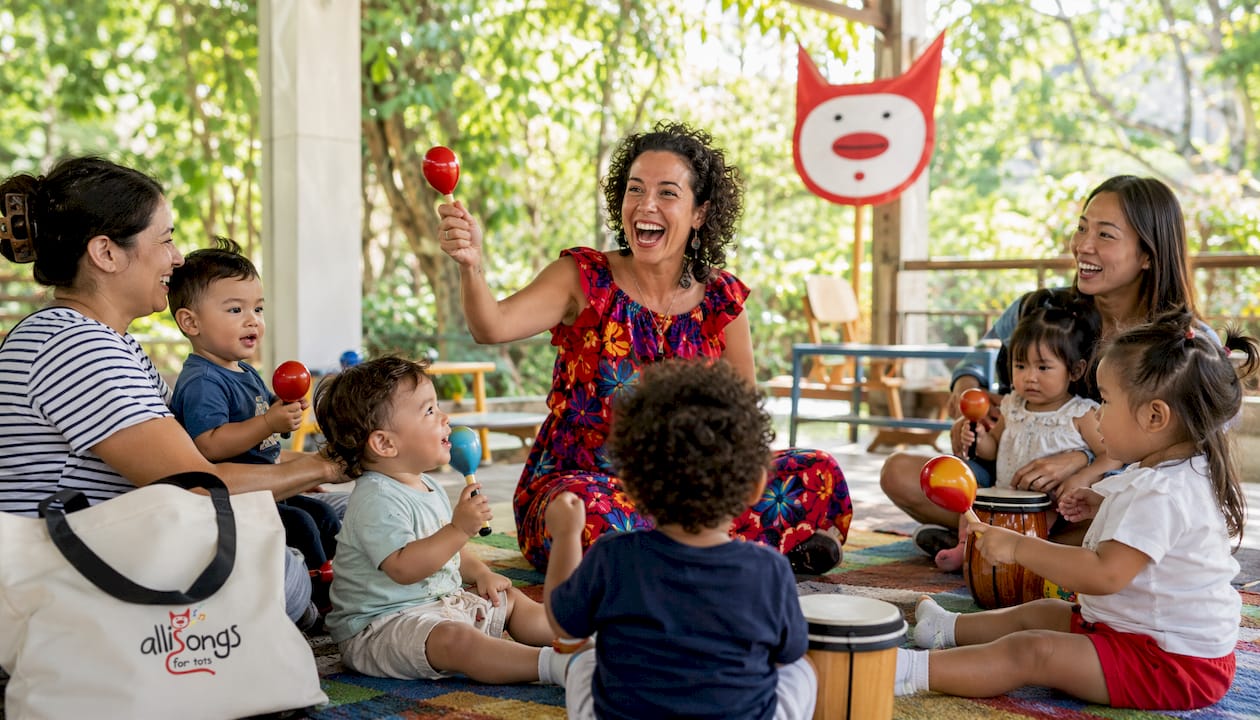
The program’s foundation in attachment theory means that adults are not passive observers. They are the primary learners, coached during each class to carry the music home and use it during feeding, bathing, and bedtime.
| Class | Ages | Format | Multicultural music |
|---|---|---|---|
| Mixed-age sessions | Birth to 5 years | Group, caregiver included | World lullabies, folk songs, original songs |
| Babies-only | 0–1 year | Small group, caregiver included | Gentle international lullabies, lap songs |
| Master classes | 3 years | Group, caregiver included | Global rhythms, multicultural repertoire |
| Introductory piano | 3 years | Small group | Culturally diverse melodies |
| Sensory art classes | Varies | Group, caregiver included | Music integrated with tactile exploration |
Families can also purchase instrument kits, songbooks, and gift certificates, making it easy to extend the multicultural music experience at home.
Key qualities that set great infant music programs apart
The strongest infant and toddler music programs share a few non-negotiable traits. They prioritize attachment and caregiver empowerment over rigid curriculum outcomes, recognizing that a secure, engaged caregiver is the most powerful musical instrument in the room. They use live music exclusively, because a teacher who can modulate her voice in response to a drowsy baby is doing something no recording can replicate. And they build in repetition, because young children learn through repeated exposure to the same songs across weeks and months, not through constant novelty.
Programs that layer too many stimuli at once, competing rhythms, multiple instruments, and visual distractions simultaneously, actually hinder learning. The one-thing-at-a-time approach is not a limitation; it is developmentally precise.
How culturally diverse music builds inclusivity from the start
When children hear music from many cultures during their earliest years, they develop what researchers describe as cultural curiosity, an openness to difference that shapes social behavior well into childhood and beyond. Singing songs from diverse traditions gives children opportunities to learn about others’ cultures while also deepening their understanding of their own. In a state as culturally rich as Florida, that kind of early exposure carries real weight.
Cultural awareness through music also builds empathy. A child who has heard a Swahili lullaby alongside an Irish folk song and a Brazilian cantiga grows up with an intuitive sense that the world is wide and worth knowing.
Popular lullabies from different cultures, with meanings
These traditional bedtime songs offer a glimpse into the global lullaby tradition:
- “Hush Little Baby” (United States): A reassuring promise from parent to child, built on simple repetition that infants find deeply calming.
- “Duerme Negrito” (Latin America): A tender Afro-Latin lullaby urging a child to sleep while a parent works; the title translates roughly as “Sleep, little dark one.”
- “Twinkle Twinkle Little Star” (French origin, “Ah! vous dirai-je, maman”): The melody originated in 18th-century France before becoming one of the most recognized children’s songs worldwide.
- “Baa Baa Black Sheep” (England): A nursery rhyme with roots in medieval English folk tradition, using simple imagery and strong rhythm.
- “Hana Hana” (Japan): A gentle body-awareness song that names facial features, supporting early language and self-recognition.
- “Thula Thula” (South Africa/Zulu): Means “hush, hush” in Zulu; its slow, rocking melody is used across southern Africa to settle infants.
- “Arrorro Mi Niño” (Spain/Latin America): A classic Spanish lullaby whose title means “lullaby, my child,” featuring soft, lilting phrasing that mirrors the rocking motion of a cradle.
How to bring world lullabies into your daily routine at home
You do not need a music degree to make lullabies from around the world part of your family’s daily life. A few practical habits go a long way:
- Sing the same song consistently at the same time each day, such as during bath time or before sleep, so your child builds a calming association with it.
- Choose one new cultural lullaby per month and learn a few words of its original language together with your child.
- Use movement: Rock, sway, or pat a gentle rhythm on your child’s back while you sing. The physical component deepens the calming effect.
- Play a global lullaby playlist softly during quiet play or wind-down time, rotating through different cultural traditions.
- Bring songs home from class: If your child attends a music program, ask the teacher for the words and melody of each new song so you can repeat it throughout the week.
Where to find recordings and books of multicultural lullabies
Building a home library of international lullabies is easier than ever. A few reliable starting points:
- Smithsonian Folkways: An extensive archive of traditional music from dozens of cultures, including lullabies and children’s songs, available for streaming and download.
- Local public libraries: Many Florida library systems carry multicultural children’s music collections, including CDs and digital lending through apps like Libby.
- Allisongs for Tots songbooks: Director Allison Wilkins has created original songbooks that families can purchase to use at home alongside class sessions.
- YouTube channels dedicated to world music for children: Search for channels that present songs in their original languages with translations and cultural context, not just anglicized versions.
- “Lullabies from the Axis of Evil” (2004): A well-regarded compilation featuring traditional lullabies from countries including Iran, Iraq, North Korea, and Syria, offering genuine cultural depth for curious families.
Key Takeaways
Multicultural lullabies support cognitive, emotional, and social development in infants and preschoolers, and caregiver involvement is the single most important factor in making that benefit last.
| Point | Details |
|---|---|
| Lullabies work in any language | Harvard’s Music Lab found infants relax to lullabies regardless of the language they are sung in. |
| Sleep onset improves with music | Toddlers fell asleep 35% faster and preschoolers 19% faster when music was used at naptime. |
| Teacher qualifications matter | Effective teachers combine music education with early childhood development expertise, not just musical skill. |
| Caregivers are primary learners | The best classes coach parents to use music at home, extending developmental benefits beyond each session. |
| Cultural authenticity counts | Authentically arranged songs from diverse traditions build genuine cultural curiosity and empathy in young children. |
FAQ
What are world lullabies?
World lullabies are traditional soothing songs from cultures around the globe, typically sung to infants and young children to promote calm and sleep. They share common acoustic features, such as slow tempo and simple melody, that researchers have found to be universally effective at relaxing babies.
Do babies respond to lullabies in languages they don’t know?
Yes. Research from Harvard’s Music Lab shows that infants relax in response to lullabies even when sung in an unfamiliar language, because the calming effect comes from acoustic qualities rather than linguistic meaning.
What should I look for in a multicultural music class for my infant?
Prioritize live music, a teacher trained in both music and early childhood development, authentic cultural repertoire, and strong caregiver participation. Small class sizes and a research-informed curriculum are also strong indicators of quality.
How does Allisongs for Tots incorporate multicultural music?
Allisongs for Tots blends lullabies from around the world with original songs by director Allison Wilkins, grounding every session in attachment theory and caregiver coaching. Classes serve children from birth through age seven across several formats in Tampa, Florida.
How often should I sing world lullabies to my child at home?
Daily repetition is most effective. Singing the same culturally diverse songs consistently at predictable times, such as bedtime or bath time, builds the calming associations and language exposure that make lullabies developmentally powerful.
