


TL;DR:
- Active music engagement builds important cognitive, language, and social skills in young children, unlike passive screen time. Regular, caregiver-led musical activities over several weeks have measurable benefits, especially in executive functions and social-emotional development. Replacing screen time with short, structured music routines fosters healthier development and stronger parent-child bonds.
For most young children, active music engagement offers clearer developmental gains than passive screen viewing. Research consistently shows that singing, moving to rhythm, and playing simple instruments build the cognitive, language, and social-emotional skills that matter most in the early years — while heavy passive screen use tends to crowd out the very activities that support those same skills.
Quick dos and don’ts:
- Do swap one daily screen session for a short music activity (singing, dancing, simple percussion).
- Do prioritize active, caregiver-led music over background audio alone.
- Don’t use screens in the hour before bed; calming music or audio-only routines work better.
- Don’t assume streamed music counts as screen time. Audio-only music is a developmentally supportive alternative when used with caregiver interaction.
Age quick-notes:
- Infants (0–12 months): Prioritize face-to-face singing and caregiver-led sound play; avoid solo screens entirely.
- Toddlers (1–3 years): Short, interactive musical games with you present; limit solo screen time to near zero.
- Preschoolers (3–5 years): Structured music activities and group classes; replace passive screen blocks with active musical play.
How passive screen time affects your child’s development
The concern with screens isn’t the device itself — it’s what passive, solo viewing displaces. When young children spend long stretches watching fast-paced content alone, they lose time for caregiver conversation, physical play, and the back-and-forth interaction that builds language and self-regulation. A 2024 structured review covering 46 studies found that higher levels of screen use are linked to reduced physical activity, poorer sleep, attention difficulties, and challenges in emotional and social functioning.
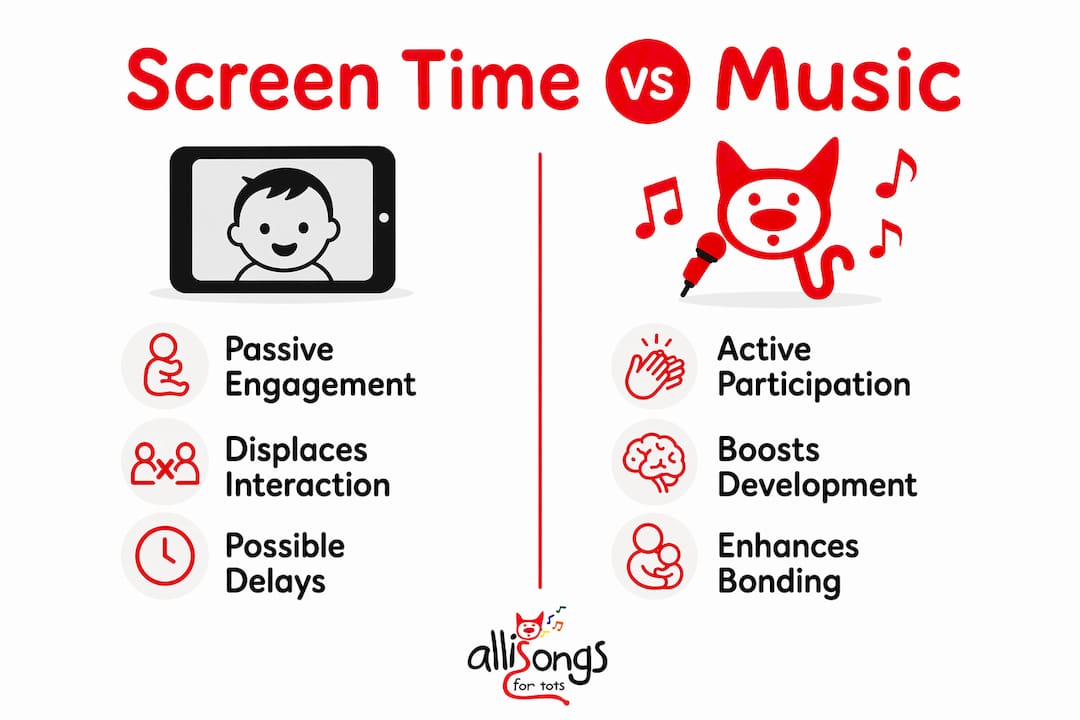
Two mechanisms drive most of the harm. First, displacement: screens crowd out sleep, outdoor play, and the caregiver interaction that young brains need most. Second, overstimulation: fast-paced, engagement-driven content can reduce a child’s ability to sustain attention on slower, more rewarding tasks. Children under two who engage in more passive media use tend to show delayed language acquisition, likely because they’re getting fewer conversational turns with adults.
The American Academy of Pediatrics has shifted its framing from simple time limits to a “digital ecosystem” lens. Content quality, caregiver interaction, and whether screens are crowding out sleep and play matter more than the clock alone. The AAP recommends family media plans, phone-free zones at meals and bedtime, and actively adding activities like music to fill the space screens would otherwise occupy.
Statistic to know: The same 46-study review found that the negative associations between screen use and development were most consistent for passive viewing — not for interactive, co-viewed content with adult involvement.
What music actually does for your child’s developing brain
Music is one of the few activities that simultaneously engages motor, language, cognitive, and social-emotional systems. That’s not a marketing claim — it’s why researchers keep returning to it as a developmental tool.
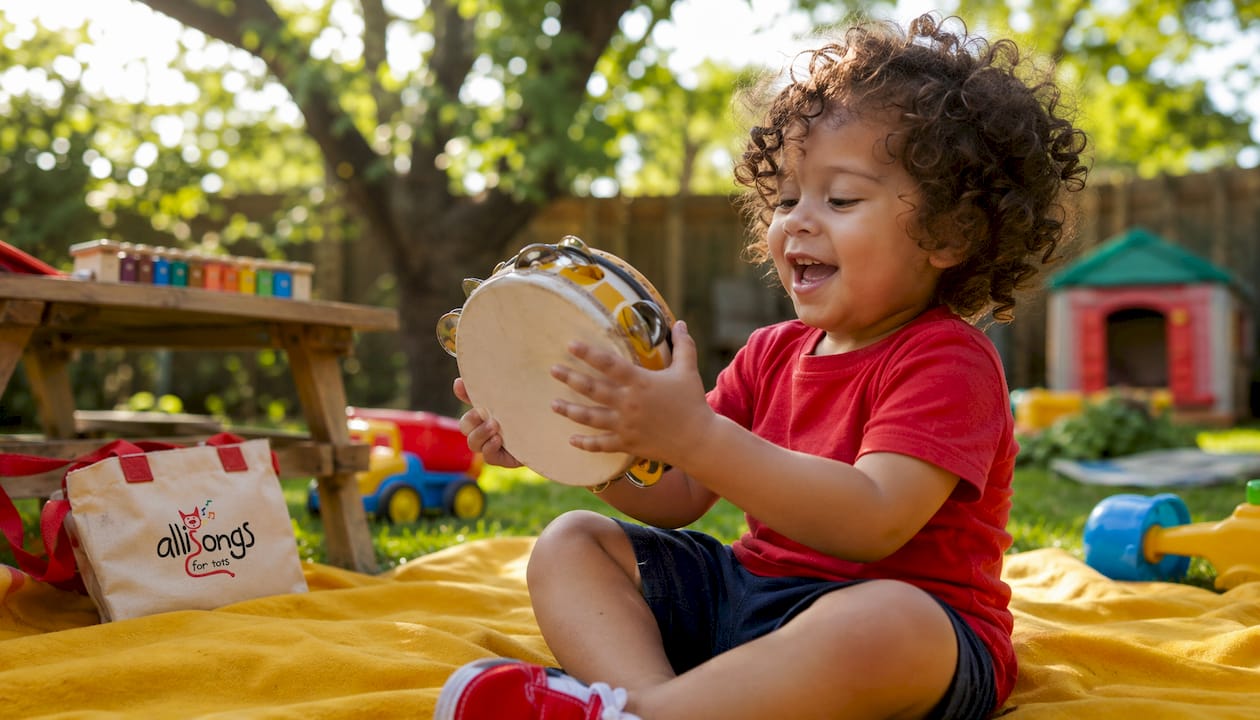
Cognitive and executive functions. Active music training builds inhibitory control (the ability to pause before acting), working memory, and cognitive flexibility. These are the same skills children need to follow classroom instructions, manage frustration, and shift between tasks. The meta-analytic evidence for these gains is meaningful, and the practical examples are simple: call-and-response songs, stop-and-go movement games, and learning a short melody all require a child to hold information, wait their turn, and adjust.
Language and early literacy. Rhythm and rhyme are natural scaffolds for phonological awareness. Singing during daily routines — bath time, getting dressed, transitions — exposes children to new vocabulary in a memorable, repetitive context. Shared musical routines also build turn-taking and joint attention, two early communication skills that predict later language development.
Motor and sensorimotor development. Keeping a beat, clapping, shaking a maraca, or tapping a drum builds both gross and fine motor coordination. Even very young children benefit from the sensorimotor feedback of sensory play paired with music, which supports body awareness and coordinated movement.
Socioemotional benefits. Caregiver-child singing is one of the most reliable bonding activities in early childhood. Group music-making teaches cooperation, emotional regulation, and reading social cues. Children who participate in regular early childhood music education tend to show stronger emotional regulation and more positive peer interactions.
What the research actually shows about dose and timeline
The strongest evidence comes from a systematic review and meta-analysis of music training programs for preschoolers aged 3–6. The findings give parents a realistic, specific target.
Effect sizes for executive functions (3–6-year-olds):
- Inhibitory control: SMD≈0.38 overall, with greater gains for longer (≥12-week) programs (SMD≈0.51).
- Working memory: SMD≈0.35 overall, with greater gains for longer (≥12-week) programs (SMD≈0.42).
- Cognitive flexibility: SMD≈0.23 overall (modest improvement).
In plain language, a standardized mean difference (SMD) in the 0.4–0.5 range is a moderate, meaningful effect — comparable to what researchers see with other structured early childhood interventions. These aren’t dramatic overnight changes; they’re steady, cumulative gains that show up most clearly after consistent participation.
| Timeline | What parents might notice |
|---|---|
| Several weeks | Improved rhythm, more engagement during music activities, some early attention gains |
| Around two to three months | Gains in inhibitory control and working memory; better turn-taking |
| Over three months | More consistent cognitive flexibility; stronger language and social-emotional skills |
Important limitations. Many screen-time studies are observational, meaning they show associations rather than direct cause and effect. Music training studies vary widely in design, session content, and control groups, which makes direct comparisons tricky. A shorter 8-week program can still improve rhythm and some early skills, but executive function gains are more reliable with longer, more frequent exposure. Parents should treat the dose targets as a practical guide, not a guarantee.
Age-specific guidance: what to prioritize at each stage
1. Infants (0–12 months)
Prioritize caregiver-led audio and face-to-face interaction above everything else. Sing directly to your baby, use call-and-response sounds, and let them feel rhythm through gentle movement. Solo screen use is discouraged at this stage; for children under 18 months, screens are largely ineffective for learning and work best avoided outside of video calls with family. The musical milestones for this age are built entirely on live, bidirectional interaction.
2. Toddlers (1–3 years)
Short, interactive musical games are the sweet spot here — think 5–10 minutes of dancing, clapping, or simple instrument play with you actively involved. If you do use screen-based music content, co-view it and narrate along rather than leaving your child to watch alone. The AAP’s updated guidance emphasizes that adult scaffolding is what makes any media experience developmentally useful at this age.
3. Preschoolers (3–5 years)
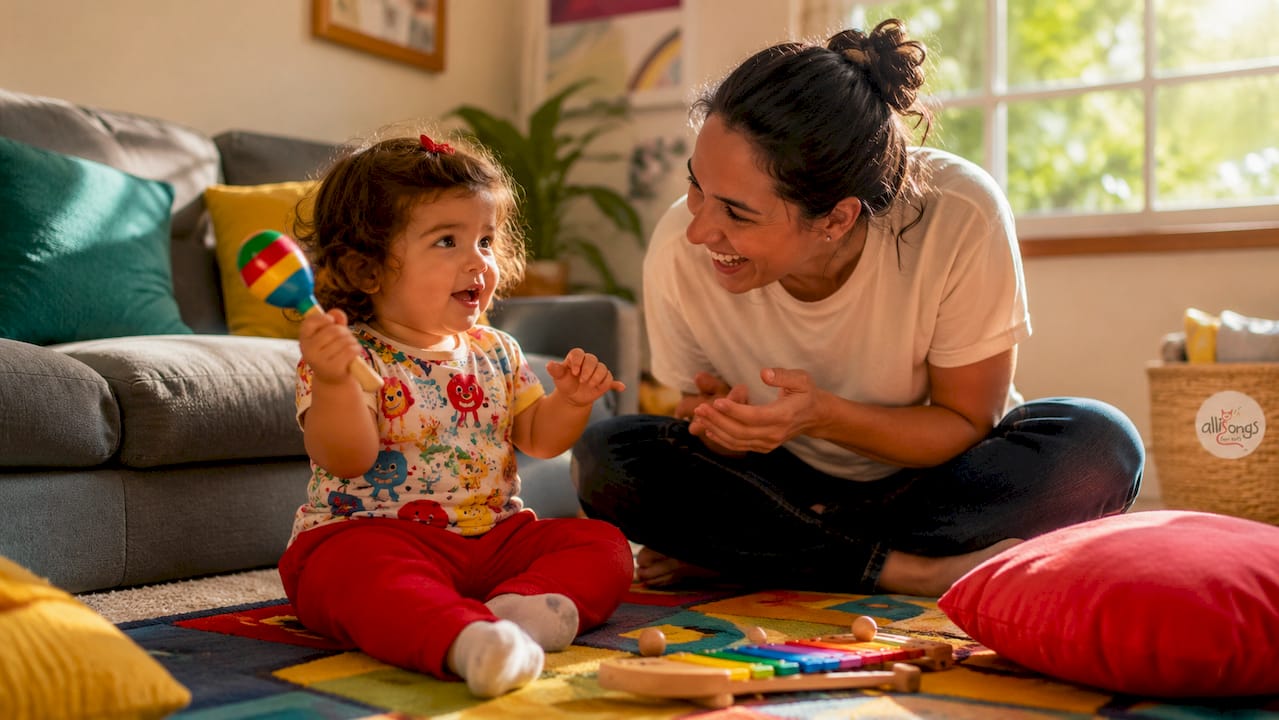
Structured music activities, simple instrument play, and group classes are all appropriate and beneficial. This is the age range where the meta-analytic evidence for executive function gains is strongest. Replace passive screen blocks — the 20-minute cartoon before dinner, the tablet during errands — with active musical play whenever you can. Group music classes add a social dimension that solo screen time simply cannot replicate.
4. The sleep and routine rule (all ages)
Avoid screens in the 60 minutes before bed. The stimulation from visual media, especially fast-paced content, interferes with the wind-down process children need for healthy sleep. A calming playlist, a lullaby, or an audio-only bedtime routine is a straightforward, evidence-consistent swap.
Practical ways to replace screen sessions with music at home
You don’t need a music room or expensive instruments to make this work. The most effective swaps are low-friction and fit into what you’re already doing.
Sample daily micro-plan:
- Morning: Play an upbeat playlist during breakfast and get-ready time; encourage your child to clap or move along.
- Commute/errands: Audio-only music instead of a screen; sing along together or play simple call-and-response games.
- Snack time: Replace the tablet with a short rhythm game using spoons on the table or a shaker made from a sealed container of rice.
- Wind-down: Swap the pre-bed screen for a quiet playlist or a caregiver-sung lullaby.
Low-cost household music kit:
- Pots and wooden spoons (percussion)
- Sealed plastic containers with dried rice or beans (shakers)
- Scarves or ribbons for movement activities
- A simple xylophone or set of hand bells (widely available for under $15)
Making music stick in a busy family:
- Pair music with transitions (a specific song that means “time to clean up” or “shoes on”).
- Use short 5–10 minute modules rather than trying to carve out a dedicated music hour.
- Model engagement yourself — children are far more likely to participate when they see you singing or moving.
- Reading aloud alongside music routines reinforces language development from multiple directions.
Pro Tip: Create a “music swap” playlist for the two or three daily moments your child most often reaches for a screen. Having it ready removes the friction of deciding in the moment, which is usually when screens win by default.
How Allisongs for Tots’ classes reflect the research
The meta-analytic evidence points to a clear model: sessions of 20–30 minutes, at least three times per week, over 12 or more weeks, with active engagement rather than passive listening. Allisongs for Tots’ class design maps directly to that framework.
Classes run in mixed-age groups (birth to five), with dedicated babies-only sessions (0–1) and master classes (3–7), so the activities are always developmentally matched. Each session runs in the 20–30 minute range and emphasizes active participation: movement, call-and-response, simple instruments, and caregiver-child interaction throughout. Director Allison Wilkins incorporates culturally diverse music alongside original compositions, which keeps the auditory environment varied and engaging across weeks.
Caregiver participation is built into every session, not optional. That design choice reflects what the research consistently shows: the developmental payoff from music comes most reliably from live, bidirectional interactions where an adult responds to the child’s cues. Parents aren’t observers here — they’re co-participants, which also strengthens the parent-child bond in ways that screen time simply doesn’t.
A realistic 12-week expectation: in the first few weeks, most children show increased engagement and rhythm response. By weeks 8–10, many families notice improved attention during music activities and better turn-taking. By week 12 and beyond, the executive function and social-emotional gains the research describes become more visible in everyday behavior. Outcomes vary by child, age, and participation level — consistent attendance and home practice between sessions make a meaningful difference.
Pro Tip: Even one or two short music sessions at home between classes significantly extends the weekly “dose” your child receives. A 10-minute sing-along on a non-class day counts.
Key Takeaways
Active music engagement, particularly in structured programs of 12 or more weeks, offers measurable developmental advantages over passive screen time for children from birth through age five.
| Point | Details |
|---|---|
| Music beats passive screens for development | Active music training produces gains in inhibitory control (SMD≈0.38 overall, SMD≈0.51 for ≥12 weeks), working memory (SMD≈0.35 overall, SMD≈0.42 for ≥12 weeks), and language for preschoolers. |
| Dose and timeline matter | Sessions of 20–30 minutes, multiple times per week, for several months produce the clearest executive function gains. |
| Screens aren’t all equal | Content quality, caregiver co-viewing, and avoiding solo use matter more than total screen minutes alone. |
| Audio-only music isn’t screen time | Playing music with the screen off doesn’t register as screen time and supports emotional regulation and sensory development. |
| Allisongs for Tots | Tampa’s research-aligned music classes for birth to five match the meta-analytic dose model with caregiver participation built in. |
The case for a 4-week experiment
Families don’t need a perfect plan to start seeing a difference. The honest truth is that most parents already know screens are filling time that could go to something more interactive — and most feel some guilt about it. What’s harder is finding a realistic alternative that actually works in a busy household.
Here’s what we’d suggest: pick two daily screen moments and replace them with music for four weeks. Don’t aim for perfection. Measure what you notice: Is your child more settled at bedtime? Are transitions a little smoother? Is there more back-and-forth conversation during the day? Those small shifts are exactly what the research predicts, and they tend to build on themselves.
The goal isn’t to ban screens. Quality content, co-viewed with a caregiver, has genuine value. The goal is to make sure music, movement, and face-to-face interaction get their fair share of the day — because that’s where the developmental work happens.
Music classes in Tampa that put the research into practice
The evidence is clear, but knowing what to do and having a structured, joyful place to do it are two different things. Allisongs for Tots offers in-person, research-based music classes for infants, toddlers, and preschoolers in Tampa — designed specifically around the dose and engagement model the studies support.
Every session includes caregiver participation, multicultural music, and original songs that keep children genuinely engaged week after week. Classes are available for children from birth through age five, with age-specific formats including babies-only sessions, mixed-age groups, master classes, and introductory piano. The social play, caregiver bonding, and developmental gains happen together — in a warm, high-energy environment that children look forward to.
Ready to try a class? Visit Allisongs for Tots to see the current schedule and register, or call 941-350-5438. Gift certificates, instrument kits, and songbooks are also available online for families who want to extend the music into their home routine.
Useful sources
These sources were selected for recency (2014–2026), study type (systematic reviews, meta-analyses, and professional policy statements), and policy relevance to U.S. families.
- Effects of music training on executive functions in preschool children aged 3–6 years: systematic review and meta-analysis — the primary meta-analytic source for dose, timeline, and effect sizes cited throughout this article.
- Digital Ecosystems, Children, and Adolescents: Policy Statement (AAP / Pediatrics) — the AAP’s current framework for evaluating screen use in context.
- A Child-Friendly Digital World: AAP Releases New Media Recommendations (HealthyChildren.org) — practical family-level guidance from the AAP’s consumer-facing platform.
- Impact of Screen Time on Development of Children (PMC) — structured review of 46 studies on screen time and developmental outcomes across physical, cognitive, emotional, and social domains.
- Infants and music media (AAP Q&A portal) — AAP expert guidance distinguishing audio-only music from visual screen time.
- Investigating the Impact of a Music Training Programme on Rhythm, Lexicon, and Executive Functions in 2- and 4-Year-Olds — peer-reviewed study showing rhythm gains from shorter programs and the importance of program length for executive function outcomes.
FAQ
Does listening to music count as screen time for kids?
No. Audio-only music with the screen off does not register as screen time on most devices, and the AAP distinguishes it from visual screen exposure. It can support emotional regulation and sensory development when used with caregiver interaction.
Is music better than screen time for children’s development?
Active music engagement generally produces clearer developmental gains than passive screen viewing, particularly for executive functions, language, and social-emotional skills. The advantage is strongest when music involves caregiver participation and consistent, regular sessions over several weeks.
What is the 3-6-9-12 rule for screen time?
The 3-6-9-12 guideline is a general framework sometimes cited in parenting resources, suggesting no screens before age 3, no personal devices before 6, no social media in the early years, and limited use before 12. The AAP’s current guidance focuses less on rigid age cutoffs and more on content quality, caregiver involvement, and whether screens are displacing sleep and active play.
How long does it take to see developmental benefits from music classes?
Research suggests that programs of 20–30 minutes per session, at least three times per week, over 12 or more weeks produce the clearest gains in inhibitory control (SMD≈0.51) and working memory (SMD≈0.42). Some rhythm and engagement improvements can appear within 6–8 weeks of consistent participation.
