


TL;DR:
- Music class activities enhance children’s development by promoting social, cognitive, and motor skills through rhythm and movement exercises. Caregiver participation and age-appropriate routines are essential for maximizing learning both in class and at home. Live music experiences and consistent routines support young children’s ongoing growth and engagement.
Music class activities are structured, interactive exercises that engage young children in rhythm, movement, and social participation to promote developmental growth. For parents and caregivers in Florida, these sessions offer far more than singing songs. Structured musical activities enhance inhibitory control, working memory, and language development in children ages 0–6. That means every clap, shake, and freeze game is building your child’s brain in real time. Allisongs for Tots has delivered this kind of research-based, caregiver-centered music education in Tampa for over 15 years.
1. Music class activities that build executive function
Executive function is the set of mental skills that helps children focus, follow rules, and manage impulses. Music class activities are one of the most effective ways to build these skills in toddlers and preschoolers.
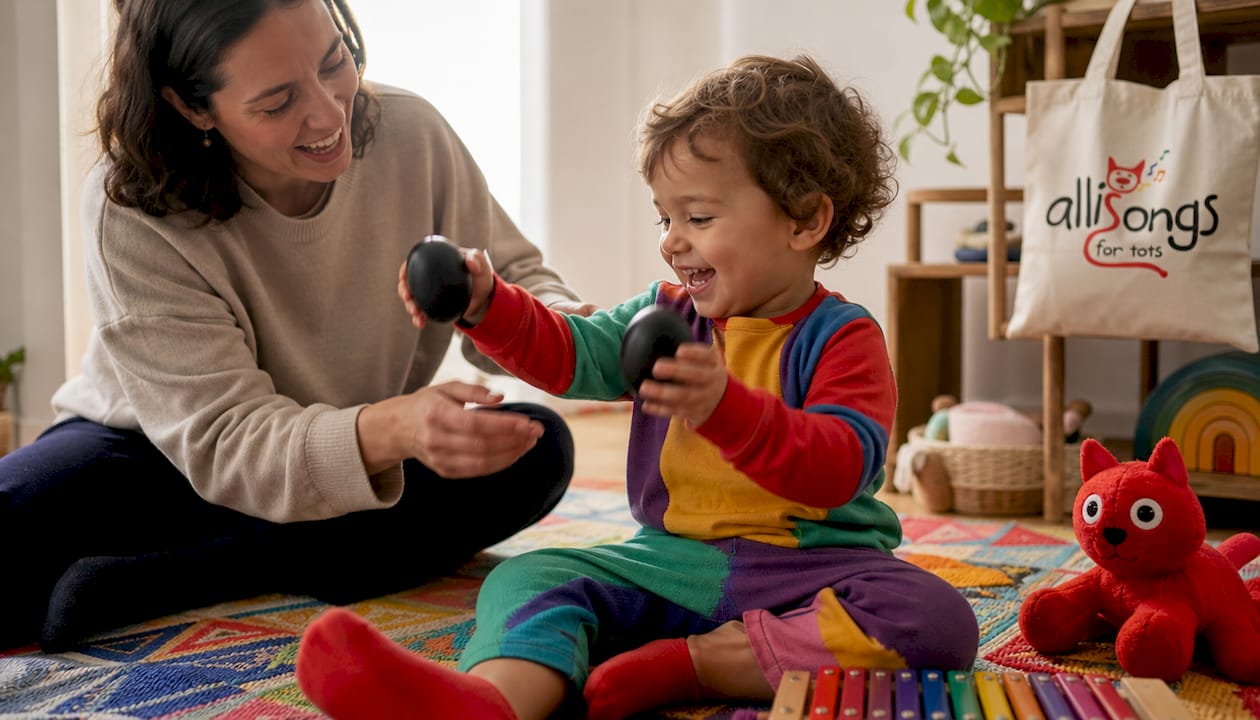
Music participation requires children to maintain goals, inhibit impulses, and update their responses in real time. That is exactly what happens when a child waits for their turn to shake a maraca or stops moving the moment the music pauses.
Here are the activity types that deliver the strongest results:
- Rhythmic clapping games. Clapping in patterns teaches children to listen and respond on cue. Start with two claps and a pause, then build complexity as attention grows.
- Freeze dance. When the music stops, children must stop moving immediately. This directly trains inhibitory control, one of the core executive functions.
- Simple percussion circles. Passing a drum or tambourine around a circle builds working memory and patience. Children must remember when their turn comes while watching others.
- Call and response songs. The teacher sings a phrase; children echo it back. This strengthens auditory memory and attention.
- Structured movement sequences. Following a series of movements tied to a song teaches children to hold a sequence in mind and execute it in order.
- Stop and go rhythm games. A leader controls the tempo, and children match it. Speeding up and slowing down on command sharpens self-regulation.
Percussion and rhythm-based activities improve self-control dimensions like persistence and delay of gratification in preschoolers after just 8 weeks of practice. That is a meaningful change in a short time.
Pro Tip: Keep sessions short for the youngest children. Infants ages 12–18 months do best with 10–15 minute sessions, while toddlers ages 1–3 thrive in 20–30 minute windows. Matching session length to attention span is the single biggest factor in keeping children engaged.
2. How group music games promote social skills and cultural appreciation
Group music settings teach children skills that solo play simply cannot replicate. Watching a peer shake a rhythm egg, waiting for a turn, and moving together as a group are all forms of social learning that happen naturally inside a music circle.
Group music classes primarily serve socialization. Not every child performs actively, and that is perfectly fine. Observation and free movement are valid forms of participation. Children absorb rhythms and social patterns before they feel ready to join in actively, a process called latent learning.
Here are four group music games and the social skills each one builds:
- The name song circle. Each child hears their name sung to a simple melody while the group claps. This builds recognition, belonging, and joint attention.
- Instrument passing games. Children pass a shaker or drum to the beat. This teaches turn-taking, patience, and awareness of others.
- Cultural rhythm exploration. Songs drawn from Caribbean, Latin American, West African, and other traditions introduce children to diverse musical styles. Allisongs for Tots weaves culturally diverse music into every session, giving Tampa families a rich auditory world to share.
- Echo and mirror movement games. One child leads a movement; the group mirrors it. This builds observation skills, cooperation, and confidence.
Cultural exposure through music is not a bonus. It is a core developmental tool. When children hear rhythms from different parts of the world, they build flexibility in listening and openness to difference. You can read more about how music supports social-emotional growth in early childhood on the Allisongs for Tots blog.
3. At-home music activities that build on class learning
A weekly music class is a strong foundation. Daily practice at home is what makes the learning stick. At-home daily 5–10 minute music routines led by caregivers have a stronger developmental impact than weekly classes alone. That is not a reason to skip class. It is a reason to bring the music home with you.
You do not need instruments or special equipment. Wooden spoons on pots, dried beans in a sealed container, and clapping hands are all you need to create a meaningful rhythm session.
Pro Tip: Pick the same time each day for your home music routine, such as after breakfast or before bath time. Consistency in routine creates a secure, predictable environment that helps toddlers engage more deeply and feel safe enough to experiment.
| Feature | Music class session | Home music session |
|---|---|---|
| Duration | 45 minutes (group format) | 5–10 minutes daily |
| Social interaction | High (peers, instructor) | Low to moderate (caregiver and child) |
| Instrument variety | Wide (drums, shakers, bells) | Household items or simple toys |
| Caregiver role | Active co-participant | Primary leader and model |
| Cultural exposure | Structured and diverse | Caregiver-directed |
| Frequency | Weekly | Daily |
The table above shows that class and home practice serve different but complementary purposes. Class gives children social breadth and structured exposure. Home practice gives them repetition and caregiver connection. Both are necessary for the best outcomes.
4. Age-appropriate activities: infants, toddlers, and preschoolers
Not every activity fits every age. Matching the activity to the developmental stage keeps children engaged and prevents frustration for both child and caregiver.
Infants (birth to 12 months)
Infants respond to sound, rhythm, and the caregiver’s voice and face. The goal is sensory exposure, not active participation. Gentle rocking to a lullaby, soft shaker sounds, and singing directly to your baby are all ideal. Keep sessions to 10 minutes or less. You can explore your child’s musical milestones from birth to age 3 to understand what to expect at each stage.
Toddlers (12 months to 3 years)
Toddlers are ready for simple participation. They can shake instruments, clap along, and begin to follow basic movement cues. Sessions of 20–30 minutes work well for this age group. Expect a mix of active engagement and watching. Both count.
- Simple percussion play with shakers and drums
- Freeze dance and stop-and-go games
- Name songs and greeting circles
- Lap bouncing songs with caregivers
Preschoolers (3 to 5 years)
Preschoolers can handle more structure and longer sequences. They enjoy call-and-response songs, instrument exploration, and movement stories where music narrates an action. Activities following the Orff-Schulwerk approach, which blends rhythmic awareness, melodic skills, and creative expression, are particularly well suited to this age. Preschoolers also benefit from group games that require listening and waiting, since these directly support the executive function skills they need for kindergarten readiness.
- Echo songs and call-and-response games
- Movement stories with musical cues
- Simple rhythm patterns on xylophones or hand drums
- Group singing with assigned parts or verses
The key principle across all ages is that adults are the most crucial participants in toddler music classes. When you model engagement, your child follows your lead. Your enthusiasm is the most powerful teaching tool in the room.
Key takeaways
The most effective music class activities combine rhythmic engagement, caregiver involvement, and age-appropriate structure to build executive function, language, and social skills in children from birth to age five.
| Point | Details |
|---|---|
| Executive function grows through rhythm | Freeze dance, percussion circles, and stop-and-go games directly train inhibitory control and working memory. |
| Group settings teach social skills | Turn-taking games, name circles, and cultural songs build cooperation and joint attention in ways solo play cannot. |
| Home practice amplifies class learning | Daily 5–10 minute caregiver-led sessions have stronger developmental impact than weekly classes alone. |
| Age determines activity format | Infants need 10-minute sensory sessions; toddlers thrive in 20–30 minutes; preschoolers can handle structured sequences. |
| Caregivers are the key ingredient | Children follow the caregiver’s lead, making adult participation the single most important factor in any music session. |
What 15 years of music classes has taught me about what really works
Parents often come to Allisongs for Tots hoping their child will sing, clap, and perform from the very first session. The truth is more interesting than that. The children who seem to be “just watching” are often absorbing the most. Latent learning is real. A child who sits quietly in a music circle for three weeks and then suddenly bursts into song on week four has been learning the whole time. Resisting the urge to push participation is one of the hardest and most important things a caregiver can do.
The second thing I have learned is that music class is caregiver coaching as much as it is child instruction. Music classes teach parents how to engage and narrate through music at home. The songs and rhythms you learn in class are tools you take home. When you sing the same song at bath time that you heard in class, your child’s brain lights up with recognition and connection.
Live music also matters more than most parents realize. Children under 3 respond better to live music with a responsive instructor than to recorded music for engagement and soothing. A guitar or ukulele played in the room, with eye contact and a warm voice, reaches young children in a way a speaker simply cannot. That is why every Allisongs for Tots session uses live music. It is not a stylistic choice. It is a developmental one.
My honest advice: come to class ready to play, not to evaluate. Sit on the floor, shake the shaker, and let your child see you having fun. That single act does more for their musical development than any curriculum ever could.
— Allisongs for Tots
Music classes in Tampa designed for your child’s development
Allisongs for Tots offers weekly 45-minute group music classes for children from birth to age five in Tampa. Every session is built around live music, caregiver participation, and a curriculum that blends original songs by director Allison Wilkins with culturally diverse musical traditions.
Classes are designed so that you and your child learn together. The infant and toddler music classes at Allisongs for Tots follow research-based practices that support cognitive, social, and motor development at every stage. Enrollment is straightforward, and the welcoming group environment makes it easy for new families to feel at home from the very first session. Spots fill quickly, so reaching out early gives you the best chance of joining a class that fits your schedule.
FAQ
What age can children start music class activities?
Children can begin music class activities from birth. Infants benefit from gentle sensory exposure through singing and soft percussion, while structured group participation becomes more appropriate from around 12 months onward.
How long should a music session be for toddlers?
Sessions of 20–30 minutes are optimal for toddlers ages 1–3. Younger infants do better with shorter 10–15 minute sessions, since attention spans are still developing at that stage.
Do shy children benefit from group music classes?
Yes. Shy children often engage through observation before active participation, a process known as latent learning. Group music classes allow children to participate at their own pace without pressure to perform.
Why is caregiver involvement so important in music classes?
Adults are the most crucial participants in toddler music classes because children model their engagement on the caregiver’s behavior. When you participate actively, your child feels safe enough to explore and join in.
Can music activities at home replace a music class?
Home music routines and group classes serve different purposes and work best together. Daily home sessions reinforce learning and build caregiver-child connection, while group classes provide social interaction, live music, and structured cultural exposure that home practice alone cannot replicate.
Recommended
- How Music Classes Strengthen Parent-Child Bonds: The Ultimate Guide
- Incorporating Music into Your Child’s Daily Routine: Easy Tips for Busy Parents
- 5 Signs Your Child is Ready for Their First Music Class | Music Education Tips
- The Role of Parents in Tampa Infant Music Classes: Support Your Child’s Musical Journey – Allisong for Tots