


TL;DR:
- Music calms infants by regulating their nervous system and encouraging motor development during tummy time.
- Caregivers should sing live, keep sessions short, and maintain a safe environment to maximize benefits.
Yes — music can make tummy time calmer, more productive, and genuinely enjoyable for both you and your baby. The combination works because predictable rhythm helps regulate your infant’s nervous system, reducing fussing and giving them the mental space to practice lifting their head and building core strength. Here is how to start right away:
- Pick your sound source. Your own voice singing a familiar song is more effective than any speaker or playlist. If you use recorded music, keep the volume moderate — soft enough that your voice stays audible over it.
- Start short. One to three minutes, several times throughout the day, is the right target for newborns. Brief and frequent beats are better than long ones.
- Stay face-to-face. Get down on the floor at your baby’s eye level. Your facial expressions and eye contact are as important as the music itself.
- Never leave baby unattended during tummy time, and wait roughly 20 minutes after a feeding before placing them on their stomach.
Quick safety note: Tummy time is always supervised floor time. The moment your baby falls asleep, flip them to their back.
Why does music improve tummy time?
Music works on tummy time through three overlapping mechanisms: state regulation, motor scaffolding, and social bonding. Understanding all three helps you use it more intentionally.
Rhythmic, predictable sound calms the infant nervous system, shifting babies from a distressed, fussy state to a calm-alert one. That calm-alert state is exactly when motor learning happens. A baby who is crying cannot practice head-lifting; a baby who is soothed and engaged can. Pediatric physical therapists describe music as a nervous-system regulator: the steady beat makes hard physical work feel safer and more manageable for infants.
Singing also creates social cues that motivate movement. When you lean in, make eye contact, and sing directly to your baby, they naturally lift their head to track your face. That head-lifting is the precise motor pattern tummy time is designed to build. Head Start guidance confirms that singing reduces infant distress more effectively than speech alone and supports multiple developmental domains simultaneously.
There is a caregiver benefit here too. Singing reduces caregiver stress and supports emotional regulation in parents, which matters because infants absorb caregiver affect. A calm, engaged parent signals safety. A tense parent, even one trying hard, can inadvertently signal alarm. Choosing music that calms you is a practical, evidence-aligned strategy, not just a nice idea. You can read more about the positive effects of music on children under two to understand the full developmental picture.
“Steady beats and repetition scaffold reaching and head-lifting by creating predictable pacing for effort.” — Physical Therapy for Infants
Age-graded music activities you can try today
These activities move from the simplest newborn sessions to more interactive play for older babies. Each one is designed for a caregiver on the floor with their child, not a screen or a toy doing the work.
0–3 months: face-to-face singalongs
- Set up. Place a firm, flat blanket on the floor. Lay baby on their tummy and position yourself directly in front of them, lying down or propped on your elbows so your face is at their level.
- Sing slowly. Choose a song you know by heart — “You Are My Sunshine,” a lullaby, or any tune that feels natural. Slow the tempo down slightly. Watch your baby’s eyes track your face.
- Add gentle rhythm. Lightly tap a steady beat on baby’s upper back or shoulders as you sing. This tactile input reinforces the auditory rhythm and encourages the nervous system to settle.
- Keep it short. One to three minutes is enough. End the session before baby shows signs of fatigue.
Pro Tip: Match your own breathing to the tempo of the song. Slower breathing calms your nervous system, and your baby will feel that shift through your touch and your voice.
3–6 months: percussion and reaching
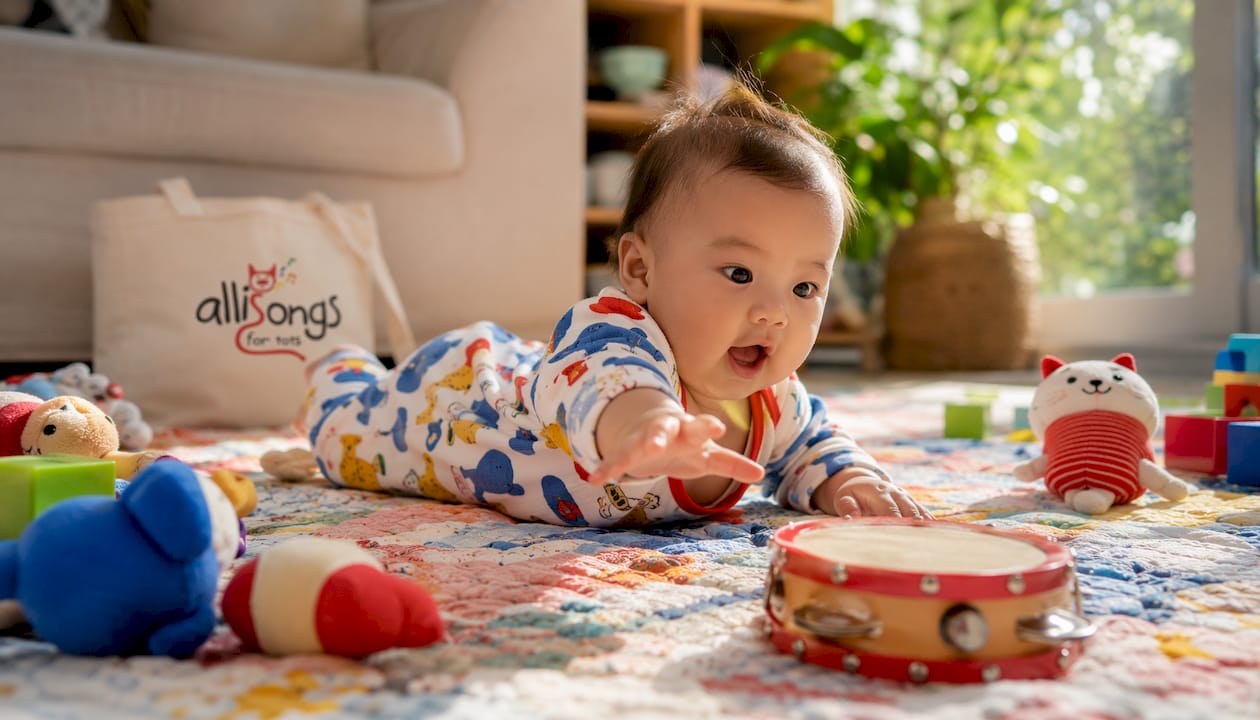
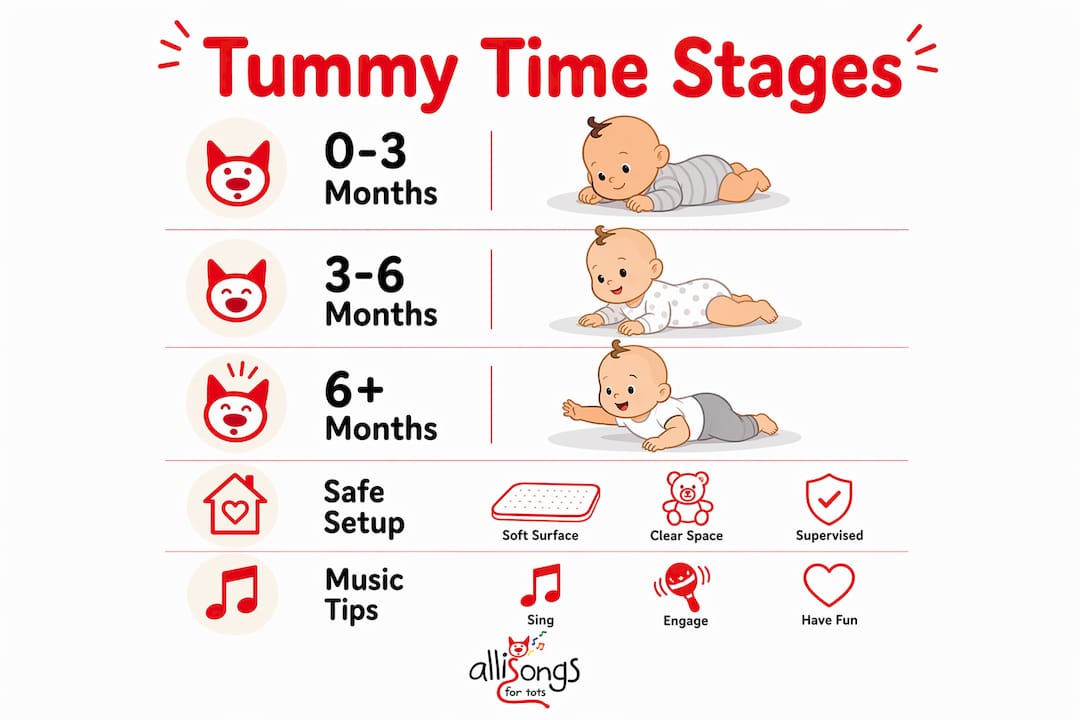
At this stage, babies can track objects and begin reaching. Add a small shaker or rattle to your sessions. Hold it slightly above and to the side of baby’s eye line and shake it in a steady beat. The reach-and-look combination strengthens neck, shoulder, and core muscles together. Sessions can extend to 5–10 minutes as your baby’s tolerance grows. Try adapting a familiar tune with new words: “Shake, shake, shake your arms / Lift your head up high” sung to a tune you already know gives baby a predictable cue for what comes next. Using familiar tunes with adapted lyrics builds sequencing and memory skills alongside motor practice.
6+ months: rolling games and call-and-response
Older babies can begin transitioning from tummy to sitting with musical support. Sing an upbeat song and gently guide baby through a tummy-to-sit movement on a repeated musical phrase. After a few sessions, many babies begin to anticipate the movement cue. Call-and-response vocal games work well here too: you sing a phrase, pause, and wait for baby to vocalize back. That back-and-forth builds language foundations while keeping baby engaged and motivated to stay on their tummy longer. For a broader look at music activities for babies and toddlers in Tampa, Allisongs for Tots has additional ideas worth exploring.

How to set up a safe, effective tummy time session
Getting the environment right matters as much as the music itself. The table below shows typical session lengths by age; the safety rules that follow apply at every stage.
| Age | Starting session length | Daily total target |
|---|---|---|
| Newborn (0–4 weeks) | 1–2 minutes | 10–15 minutes |
| 1–3 months | 2–5 minutes | 20 minutes |
| 3–6 months | 5–10 minutes | — |
| 6+ months | 10–15 minutes | As tolerated |
Surface and positioning:
- Use a firm, flat surface — a play mat on the floor is ideal. Avoid soft surfaces like sofas or adult beds.
- Keep the area clear of loose fabric, pillows, or toys that could obstruct the airway.
- Always watch baby’s face and airway. If their head drops and they cannot lift it, the session is over.
Timing and feeding:
- Start tummy time on your baby’s first day home from the hospital. Early and often is the right approach.
- Wait a short period after feeding to reduce the chance of spitting up and avoid pairing discomfort with the activity.
Volume:
- Keep music at a conversational level. Your voice should always be clearly audible over any recorded sound. Loud speakers placed close to baby’s ears are not appropriate.
Red flags — stop the session if you see:
- Persistent coughing or gagging
- Color changes around the mouth or face
- Extreme arching of the back with inconsolable crying
- Baby falling asleep (flip to back immediately)
Understanding the broader developmental advantages of floor time can help you see tummy time as one piece of a larger movement picture.
How to use tempo and repetition to shift baby’s state
Choosing the right music for the moment is a skill, and it is simpler than it sounds. The key is matching your music choice to your goal for that session.
- Goal: calm a fussy baby before motor practice. Choose slow, steady music — 60–80 beats per minute, roughly the pace of a resting heartbeat. Lullabies, gentle folk songs, or slow acoustic music all work. Sing softly and let the rhythm do the settling work before you ask baby to do anything effortful.
- Goal: energize and engage for active reaching. Switch to a slightly faster, brighter tempo once baby is calm-alert. Upbeat nursery rhymes or simple percussion-driven songs encourage movement and attention.
- Goal: signal a transition. Use a consistent song to mark the start and end of every tummy time session. Predictable cues help babies anticipate what is coming, which reduces resistance over time.
Repetition is your most powerful tool. Babies learn through repeated exposure to the same patterns. Singing the same two or three songs across multiple sessions in a day gives baby a reliable framework for effort. When they hear the opening notes of “their” tummy time song, their nervous system begins to prepare. That anticipation is the foundation of rhythm introduction for motor skills.
“Predictable musical pacing gives infants a framework for effort — they learn when to push and when to rest, which makes sustained motor practice possible.” — Physical Therapy for Infants
You can also layer cues: sing, tap a gentle beat on baby’s back, and make eye contact simultaneously. That multi-sensory input reinforces the motor pattern from several directions at once. For guidance on using music to support emotional regulation through music, the same principles apply as babies grow into toddlers.
When does a structured infant music class help?
Home practice is valuable, but there are clear signs that a guided class would add something your living room cannot.
- You are struggling to establish a consistent routine. A weekly class creates an external anchor for your practice schedule and gives you new material to use at home between sessions.
- You want to see proper technique modeled. Watching a trained instructor demonstrate positioning, volume, and caregiver interaction in real time is more instructive than reading about it. Live, face-to-face instruction consistently outperforms recorded content for building caregiver confidence and correct technique.
- You want community. Tummy time can feel isolating, especially in the early weeks. A class puts you in a room with other caregivers navigating the same stage, which normalizes the challenge and builds support.
- Your baby is resistant and you are running out of ideas. A skilled instructor can observe your baby’s responses and suggest adjustments you would not think of on your own.
A high-quality infant music class will include live singing, small instruments, developmentally sequenced activities, and explicit guidance on positioning and safety. Caregiver participation is not optional — it is the point. You are learning alongside your baby, not dropping them off. The role of parents in infant music classes is central to how these sessions produce lasting results at home.
Allisongs for Tots in Tampa offers a dedicated babies-only class for infants from birth to 12 months, as well as mixed-age sessions for families with children from birth to five. Director Allison Wilkins brings over 15 years of infant music instruction to every session, combining multicultural music with original songs designed to support the exact developmental goals tummy time targets: head control, reaching, social engagement, and caregiver bonding.
Key Takeaways
Music and tummy time work best together when a caregiver sings live, keeps sessions short and frequent, and matches the music’s tempo to the baby’s current state.
| Point | Details |
|---|---|
| Music regulates infant state | Predictable rhythm shifts babies from fussy to calm-alert, the state where motor learning happens. |
| Start on day one | Begin short sessions from your baby’s first day home; brief and frequent sessions outperform long, infrequent ones. |
| Caregiver voice first | Your live singing is more effective than any recorded playlist for bonding, attention, and motor motivation. |
| Safety rules are non-negotiable | Always supervise, wait ~20 minutes after feeding, keep volume moderate, and stop if baby shows distress signals. |
| Allisongs for Tots | Tampa’s babies-only and mixed-age classes offer live, instructor-led music sessions designed for tummy-time goals. |
What 15 years in the room has taught us
The babies who make the fastest progress in tummy time are almost never the ones whose parents bought the most gear. They are the ones whose caregivers got on the floor and sang. That pattern shows up session after session in infant music classes: a baby who has been resistant to tummy time for weeks will suddenly lift their head when a familiar voice starts singing directly to them. The music is not magic. It is the combination of a predictable sound, a trusted face, and a caregiver who is calm enough to make the whole thing feel safe.
Fifteen-plus years of leading infant music classes at Allisongs for Tots has reinforced one thing above all: the caregiver’s emotional state is the most powerful variable in the room. When you are tense about tummy time, your baby feels it. When you are singing something you enjoy, your body relaxes, your voice softens, and your baby gets the signal that this is a safe place to work hard. You do not need a perfect playlist or a special toy. You need two minutes, a firm floor, and a song you know by heart. Start there, and build from what you observe.
Allisongs for Tots supports your tummy time goals
Knowing the research is one thing. Having a trained instructor beside you, modeling exactly how to position your baby, when to switch songs, and how to read your infant’s cues, is something different entirely.

Allisongs for Tots offers babies-only classes for infants from birth to 12 months, where every session is built around the caregiver-participation model that makes music-led tummy time work at home too. Mixed-age sessions welcome families with children from birth to five, so siblings can join without anyone being left out. Instrument kits and songbooks are available for purchase if you want to reinforce what you learn in class between sessions. Director Allison Wilkins has spent over 15 years crafting research-based, culturally rich programming that meets babies where they are developmentally and gives caregivers the confidence to keep going at home.
Ready to see it in action? Register for a class or reach out at 941-350-5438 with questions about which session fits your baby’s age and stage. Families in the Tampa area can also ask about upcoming special events and gift certificates for new parents.
Useful sources
- Using Music with Infants, Toddlers, and Their Families — Head Start (ECLKC)
- Tummy Time Is Important for Your Baby — St. Louis Children’s Hospital
- How Music Makes Tummy Time Easier for Baby — Physical Therapy for Infants
- Infants Recognize Melodies Heard in the Womb — NBC News
- How Do Babies Respond to Music in the Womb? — Parenting Science
- Tummy Time Songs — KidsongsTV Blog
- When Can My Unborn Baby Hear Me? — HealthyChildren.org (AAP)
- Music Milestones: Your Child’s Musical Journey from 0–3 Years — Allisongs for Tots
- Why Babies Need Floor Time — Baby Bare Essentials
FAQ
When should you start tummy time with music?
Start tummy time on your baby’s first day home from the hospital, and music can be part of it from the very beginning. Even a simple lullaby sung during a one-minute session helps establish a positive routine.
Do babies recognize music they heard in the womb?
Yes. Research shows that melodies played repeatedly in late pregnancy produce stronger responses in newborns when heard again after birth, though researchers note there is no biological need for extra prenatal auditory stimulation.
What activities count as tummy time?
Any supervised time your baby spends on their stomach counts, including lying on your chest, on a firm floor mat, or over your lap. Adding singing or gentle percussion during these positions makes the session more engaging and developmentally productive.
Is music safe for young babies during tummy time?
Yes, with one important rule: keep the volume at a conversational level. Your voice should always be audible over any recorded music, and speakers should never be placed directly next to baby’s ears.
How does Allisongs for Tots support tummy time goals?
Allisongs for Tots offers babies-only classes in Tampa where live singing, small instruments, and caregiver participation are built into every session, giving parents the skills and confidence to continue music-led tummy time at home.
