


TL;DR:
- Music engagement, especially active and social participation, produces measurable brain and cognitive improvements in children. Early and consistent training enhances executive functions, language, and memory, with benefits persisting when programs incorporate caregiver involvement and multisensory activities. Starting before age seven leverages heightened neural plasticity, but meaningful gains remain possible at any age with regular practice.
Yes — music meaningfully shapes brain development, especially when engagement is active, social, and sustained. The evidence for this is not anecdotal; it comes from peer-reviewed systematic reviews, longitudinal neuroimaging studies, and meta-analyses tracking hundreds of children across months and years of musical training.
Here is what the research shows most clearly:
- A PMC systematic review and meta-analysis of preschoolers aged 3–6 found that music training produced measurable improvements in executive functions: inhibitory control (SMD = 0.38), working memory (SMD = 0.35), and cognitive flexibility (SMD = 0.23), with stronger gains when training lasted at least 12 weeks.
- A landmark Journal of Neuroscience longitudinal study found regional structural brain changes in motor and auditory areas after just 15 months of instrumental training in young children, with those changes correlating directly with behavioral improvements.
- Programs that combine active music-making, caregiver involvement, and social interaction, like those offered by Allisongs for Tots in Tampa, align closely with the program features that research identifies as most effective.
What matters most is not simply whether a child hears music, but how they engage with it. Active production (singing, playing, moving) consistently outperforms passive listening. Dosage matters too: weeks of consistent practice, not a single session, is what drives measurable change. And the social, multisensory context of group music-making amplifies transfer effects to language, memory, and self-regulation.
How music lights up your child’s brain
Music is one of the most neurologically demanding activities a human brain can perform. When a child sings a song, claps a rhythm, or plays a simple instrument, the brain is not just processing sound. It is coordinating perception, movement, memory, emotion, and social attention all at once.
The key regions involved include:
- Auditory cortex: Processes pitch, melody, rhythm, and timbre; the primary entry point for musical sound.
- Motor cortex: Coordinates movement and rhythm production; activated even when people imagine music without moving.
- Corpus callosum: The thick band of fibers connecting the brain’s two hemispheres; enlarged in trained musicians, supporting faster cross-hemisphere communication.
- Hippocampus: Central to memory formation and spatial navigation; activated during music listening and linked to social bonding and emotional memory.
- Amygdala: Processes emotional responses to music, including the chills or comfort a familiar melody can trigger.
- Nucleus accumbens: Part of the brain’s dopaminergic reward system; releases dopamine in response to pleasurable music, which supports motivation and sustained engagement.
- Prefrontal cortex: Governs executive functions like planning, impulse control, and working memory; recruited heavily during complex musical tasks.
- Cerebellum: Manages timing, coordination, and fine motor control; critical for rhythm and beat perception.
These regions do not operate in isolation. Music activates what neuroscientists call sensorimotor coupling, the tight link between hearing a beat and the motor system’s urge to move with it. Temporal prediction, the brain’s ability to anticipate when the next beat will arrive, trains the prefrontal and cerebellar networks that also underlie reading fluency and attention. The reward system’s involvement explains why children stay engaged: music is intrinsically motivating in a way that flashcard drills rarely are.
A useful way to picture this is as a left-to-right flow: sound input arrives at the auditory cortex, which feeds into sensorimotor loops (motor cortex and cerebellum), which in turn recruit prefrontal networks for planning and control, while the hippocampus and amygdala handle memory encoding and emotional response, and the nucleus accumbens keeps the whole system motivated. That is a lot of brain real estate activated by a single nursery rhyme.
Research using fMRI and EEG confirms that music processing involves a widespread bilateral network of frontal, temporal, parietal, and subcortical areas, extending well beyond the auditory cortex into regions associated with attention, motor function, memory, and emotional regulation. This breadth is precisely why musical training can produce transfer effects into non-musical cognitive domains.

What the research actually shows about training and neuroplasticity
Not all evidence is created equal, and understanding study design helps you weigh the claims you will encounter.
Cross-sectional studies compare trained musicians with non-musicians at a single point in time. They consistently show structural and functional differences, but cannot rule out the possibility that people with certain brain traits are simply more likely to pursue music. Longitudinal studies track the same children before and after training, providing much stronger evidence that observed changes are caused by training rather than pre-existing differences. Randomized controlled interventions go further by randomly assigning children to music or active-control conditions, controlling for motivation and parental involvement. Meta-analyses pool effect sizes across dozens of studies to identify consistent patterns.
| Study | Design | Age Range | Duration | Key Outcome |
|---|---|---|---|---|
| Longitudinal study / Journal of Neuroscience | Longitudinal with controls | ~5–6 years | 15 months | Structural changes in motor and auditory brain areas; correlated with behavioral gains |
| Habibi et al. (2017) | Longitudinal with controls | 6–7 years | 2 years | Asymmetric cortical thickness changes; increased fractional anisotropy in corpus callosum |
| PMC Meta-analysis (2024) | Systematic review/meta-analysis | 3–6 years | ≥12 weeks | EF improvements: inhibitory control SMD = 0.38, working memory SMD = 0.35, cognitive flexibility SMD = 0.23 |
| Frontiers Meta-analysis (2025) | Three-level meta-analysis | 3–12 years | Varied | Overall EF improvement g = 0.350 across 46 studies, N = 3,530 |
The Habibi et al. longitudinal study is particularly instructive because it tracked 6–7-year-olds over two years of music training and found both cortical thickness changes and increased fractional anisotropy (FA) in corpus callosum segments compared with matched controls. FA is a measure of white matter integrity from diffusion tensor imaging (DTI); higher FA in the corpus callosum suggests more efficient communication between hemispheres, which supports reading, attention, and language processing.
Neuroimaging methods used across these studies include structural MRI (measuring cortical thickness and gray matter volume), DTI (measuring white matter tract integrity), EEG and event-related potentials (ERPs, measuring the brain’s real-time electrical response to sound), and standardized behavioral tests of executive function, phonological awareness, and working memory. Each method captures a different layer of the same story: music training reshapes the brain at both the structural and functional level, and those changes show up in behavior.
The PMC review of musical training, neuroplasticity, and cognition synthesizes this evidence comprehensively, confirming that long-term musical practice is associated with structural and functional brain differences across multiple regions, and that these differences are linked to cognitive advantages in trained individuals.
Which cognitive skills benefit most from musical engagement?
The evidence is not uniform across all cognitive domains. Some areas show consistent, replicated gains; others are promising but mixed. Here is a domain-by-domain map.

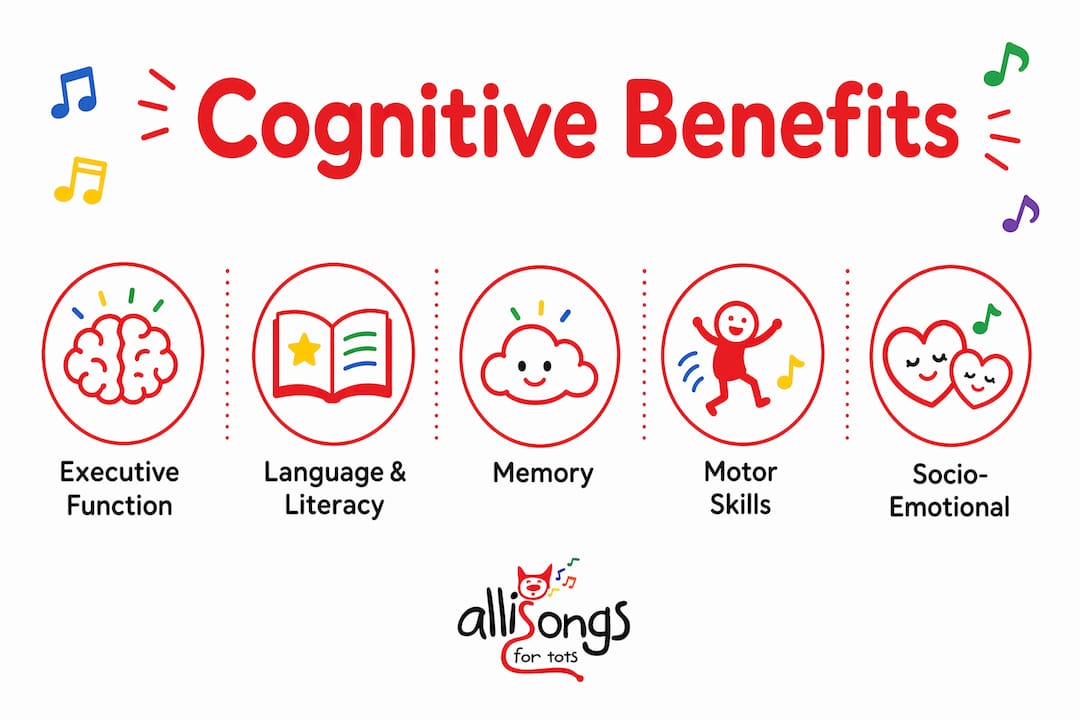
Language and literacy (evidence: strong)
Rhythm training sharpens phonological awareness, the ability to hear and manipulate the sound units of language, which is one of the strongest predictors of reading success. Children who receive music training tend to show better phoneme discrimination, stronger auditory working memory for verbal material, and faster reading development. The connection between music and language is grounded in shared neural resources: both rely on the auditory cortex, temporal lobe, and Broca’s area for processing sequential sound patterns.
Executive function (evidence: strong)
This is where the meta-analytic evidence is most consistent. A three-level meta-analysis of 46 studies involving 3,530 children aged 3–12 found an overall EF improvement of g = 0.350, with inhibitory control showing the largest gains. Rhythm practice in particular demands that children stop, start, and wait on cue, which directly trains inhibitory control. Ensemble playing adds working memory load (holding your part while listening to others) and cognitive flexibility (adjusting in real time).
Memory (evidence: moderate to strong)
Music activates the hippocampus, which encodes episodic and semantic memories. Children who learn songs with lyrics retain vocabulary better than those who receive spoken instruction alone, a finding replicated across several language-learning studies. Melodic contour also serves as a retrieval cue, which is why we remember the alphabet song decades later.
Spatial-temporal reasoning (evidence: moderate)
Early studies suggested music training improved spatial-temporal skills relevant to mathematics, though effect sizes in more recent controlled studies are smaller than initially reported. The relationship appears real but modest, and is likely mediated by the same executive function gains rather than a direct music-to-math transfer.
Motor skills (evidence: strong for trained movements)
Instrument training produces clear improvements in fine motor coordination and timing precision. These gains are near-transfer effects, meaning they are strongest for the specific movements practiced, though rhythmic training also generalizes to gross motor coordination and gait.
Socio-emotional development (evidence: moderate, growing)
Group music-making builds joint attention, turn-taking, and emotional regulation. The social-emotional benefits of music are supported by research showing that synchronized movement and singing increase prosocial behavior and cooperation in young children. Music also activates the reward system in ways that reduce cortisol (a stress marker), supporting emotional regulation.
A note on confounds
Studies linking music training to cognitive gains face a persistent challenge: families who enroll children in music programs tend to have higher socioeconomic status, more parental involvement, and children with stronger baseline cognitive abilities. Higher-quality studies address this through randomization, active control conditions (e.g., visual arts training instead of no treatment), and longitudinal baseline measures. When these controls are in place, music training effects remain, though effect sizes are more modest than early cross-sectional studies suggested. Active, social, multisensory training consistently produces stronger transfer effects than passive listening, regardless of socioeconomic background.
When and how much musical experience matters
The concept of a sensitive period refers to a window of heightened neural plasticity during which the brain is especially receptive to certain types of input. For music, the most commonly cited sensitive period falls roughly before age 7, when auditory and motor circuits are developing rapidly and the brain’s capacity for structural reorganization is at its peak.
Critically, a sensitive period is not a deadline. Research, including insights from longitudinal studies on early music onset, confirms that children who begin training later still show meaningful gains; the early window simply offers a period of heightened receptivity where the same amount of training may produce larger structural changes. The Habibi et al. study found significant corpus callosum changes in 6–7-year-olds after two years of training, and the JNeurosci study showed structural changes after 15 months in similarly aged children.
Age-related evidence at a glance:
- Birth to 12 months: The auditory system is highly plastic; exposure to diverse musical sounds (pitch, rhythm, timbre) shapes early auditory discrimination and lays the foundation for language sound processing.
- 1–3 years: Children begin to synchronize movement with a beat, a precursor to both rhythm and language fluency. Caregiver-child musical play supports joint attention and early social bonding.
- 3–5 years: Structured music activities targeting rhythm, melody, and call-and-response patterns show the strongest executive function gains in meta-analytic data. This is the age range where the PMC meta-analysis found SMDs of 0.38 for inhibitory control, 0.35 for working memory, and 0.23 for cognitive flexibility.
- 5–7 years: Formal instrument training becomes productive; structural brain changes (corpus callosum, motor and auditory cortex) are measurable within 15–24 months of consistent practice.
- After age 7: Training still produces cognitive and structural benefits, though the magnitude of some structural changes may be smaller. Consistency and duration remain the primary drivers of outcome.
Dosage heuristics from the meta-analytic evidence:
The PMC meta-analysis found that training lasting at least 12 weeks was necessary for significant EF gains to emerge, with some subgroup analyses pointing to three or more sessions per week and session lengths of 20–40 minutes as associated with stronger outcomes. This does not mean shorter programs are worthless; it means that consistency over time is what allows the brain to consolidate new neural patterns.
Pro Tip: Prioritize consistency and enjoyment over early professionalization. A child who attends one joyful, interactive music class per week for a full school year will likely show more measurable development than a child who attends intensive lessons for six weeks and then stops. The brain needs repeated, spaced exposure to build durable neural pathways, and a child who loves music will keep coming back.
Clinical and therapeutic applications: what the evidence supports
The same neural mechanisms that make music effective for child development also make it a promising tool in clinical and rehabilitation settings, though the evidence base varies considerably by condition and outcome.
Dementia and cognitive aging
Observational studies and review-level evidence suggest that musical engagement correlates with lower dementia risk, likely because sustained musical activity builds cognitive reserve over a lifetime. People who have played instruments or sung regularly throughout their lives show delayed onset of cognitive decline in some longitudinal cohorts. However, these are associational findings; randomized controlled trials demonstrating that starting music in older adulthood prevents dementia are limited, and causal claims remain premature.
Music therapy interventions in people already living with dementia show more consistent short-term benefits: improved mood, reduced agitation, and enhanced autobiographical memory recall, particularly when familiar music is used. The hippocampal and limbic activation triggered by personally meaningful music appears to access memory networks that remain relatively intact even in moderate Alzheimer’s disease.
Parkinson’s disease
Rhythmic auditory stimulation (RAS), a technique in which patients walk or move to an externally provided rhythmic beat, has shown consistent improvements in gait speed, stride length, and cadence in people with Parkinson’s disease. The mechanism involves the cerebellum and basal ganglia using the external rhythm as a timing scaffold to compensate for the internal timing deficits characteristic of the condition. Group drumming and singing programs have also been associated with improved mood and social engagement in this population.
Mood and mental health
Music activates dopaminergic reward pathways and reduces cortisol levels, supporting its use in stress reduction and mood regulation. Group singing in particular has been associated with increased oxytocin release and reduced anxiety in several small trials. These effects are real but modest, and music-based interventions work best as complements to, not replacements for, evidence-based mental health treatment.
Limits of the evidence
Across all clinical applications, the field faces common challenges: small sample sizes, heterogeneous intervention designs (live vs. recorded, active vs. receptive, individual vs. group), and limited long-term follow-up. Effect sizes in clinical populations tend to be small to moderate. The most responsible framing is that musical engagement is a low-risk, high-engagement activity with genuine neurological and emotional benefits, but it is not a cure, and the strength of evidence varies significantly by condition and outcome.
Research-based activities and program features that support brain development
Translating neuroscience into classroom practice requires more than playing music in the background. The activities and program structures below are grounded in the mechanisms described earlier and organized by age band.
Age-banded activity guide
0–12 months
- Lullabies and vocal play: Caregiver singing supports auditory discrimination and emotional bonding through limbic activation; vary pitch and tempo to build sound categorization.
- Gentle rhythm tapping: Tapping a beat on the baby’s back or hands during songs begins sensorimotor coupling; music for children under two supports early neural foundations.
- Sound exploration with simple instruments: Shakers, bells, and drums allow infants to connect motor action with auditory feedback, building cause-and-effect understanding.
1–3 years
- Call-and-response singing: Builds auditory discrimination, turn-taking, and early phonological awareness; the child listens, waits, and responds, directly training inhibitory control.
- Beat-keeping with body percussion: Clapping, stomping, and patting to a steady beat develops temporal prediction and gross motor coordination; tracking music milestones at 0–3 years helps caregivers set realistic expectations.
- Simple movement songs: Songs with actions (stop/go, fast/slow) directly target inhibitory control and cognitive flexibility.
3–5 years
- Rhythm games with instruments: Structured turn-taking with drums or rhythm sticks targets working memory (holding the pattern) and inhibitory control (waiting for your turn).
- Singing with lyrics: Melodic encoding of vocabulary and concepts supports language development and memory consolidation.
- Ensemble play: Even simple two-part arrangements require children to hold their own part while listening to others, building cognitive flexibility and joint attention.
Early school age (5–7 years)
- Formal instrument introduction: Piano, violin, or Orff instruments; structured practice builds fine motor skills, reading notation (visual-spatial processing), and sustained attention.
- Improvisation activities: Open-ended musical creation supports creative thinking and emotional expression.
- Multicultural repertoire: Exposure to diverse musical styles and scales expands auditory discrimination and cultural awareness simultaneously. Pairing music with sensory play activities can deepen multisensory engagement at this stage.
Program design checklist for educators
Research consistently shows that pedagogical quality matters as much as raw practice hours. When evaluating or designing a music program, look for:
- Active production over passive listening: Children sing, play, and move rather than only observe.
- Social interaction built in: Group formats, partner activities, and ensemble play are prioritized.
- Caregiver participation: Especially for children under five, adult involvement strengthens joint attention and emotional security.
- Consistent frequency and duration: At least 12 weeks of regular sessions, ideally two to three times per week.
- Multisensory elements: Movement, visual cues, tactile instruments, and vocal production are combined.
- Trained, engaged instructors: Teacher responsiveness and warmth influence outcomes independently of curriculum content.
- Culturally diverse repertoire: Broad musical exposure supports richer auditory discrimination and inclusive learning environments.
Sample 30–45 minute session outline (mixed-age toddler class)
Warm-up (5 minutes): Greeting song with name recognition; builds social awareness and sets a predictable routine that supports emotional regulation.
Core activity 1 (10 minutes): Instrument exploration with a structured rhythm game; targets inhibitory control, fine motor skills, and auditory discrimination.
Core activity 2 (10 minutes): Call-and-response song with movement; targets phonological awareness, gross motor coordination, and joint attention.
Transition song (5 minutes): A consistent melody used to signal activity changes; reduces anxiety and builds temporal prediction.
Closing (5–10 minutes): Caregiver-child paired activity (lap bounces, gentle rocking songs); reinforces bonding, emotional regulation, and the social reward of shared music-making.
Measuring progress modestly: You do not need formal neuroimaging to see whether a program is working. Simple behavioral markers include: increased on-task time during music activities, spontaneous beat-keeping outside of class, improved turn-taking in group settings, and caregiver reports of song use at home during transitions or emotional moments.
Pro Tip: Caregiver involvement is not just a nice feature; it is a research-supported moderator of outcomes. When parents and caregivers actively participate rather than observe, children show stronger joint attention, greater emotional engagement, and faster skill consolidation. Design every session so caregivers have a clear, active role.
Key Takeaways
Active, social, and sustained musical engagement produces measurable brain changes and modest-to-moderate cognitive gains, with the strongest evidence for executive function, language, and memory in children aged 3–12.
| Point | Details |
|---|---|
| Active engagement drives change | Singing, playing, and moving produce stronger cognitive gains than passive music listening alone. |
| Dosage and consistency matter | Training lasting at least 12 weeks, ideally two to three sessions per week, is needed for measurable executive function gains. |
| Sensitive periods are real but not absolute | Starting before age 7 offers heightened plasticity, but consistent training at any age produces meaningful benefits. |
| Effect sizes are modest but meaningful | Meta-analyses report EF improvements of about g = 0.350; real gains, not transformative miracles. |
| Allisongs for Tots aligns with the evidence | Classes combine active production, caregiver participation, social interaction, and multicultural repertoire, the features research identifies as most effective. |
A practitioner’s perspective on music and learning
At Allisongs for Tots, the research on music and brain development is not just background reading. It shapes every decision about how classes are structured, from the way caregivers are invited into the circle rather than seated on the sidelines, to the deliberate mix of original songs and culturally diverse repertoire that director Allison Wilkins has developed over more than 15 years of working with Tampa families.
What the neuroscience confirms, and what we see reflected in our classes week after week, is that the social context of music-making is not incidental. It is the mechanism. When a caregiver and child lock eyes during a call-and-response song, when a toddler waits for their turn to shake the maraca, when a group of mixed-age children moves together to a steady beat, those moments are not just charming. They are the brain building executive function, emotional regulation, and language circuits in real time. The research on group music classes for toddlers confirms what practitioners have long observed: the social dimension amplifies every other benefit.
One thing the research does not always capture is the cumulative effect of a consistent musical community over months and years. Families who stay with a program through multiple class cycles report that their children begin to use music independently, reaching for songs during transitions, using rhythm to self-regulate, and showing a confidence in group settings that extends well beyond the music room. That is the long arc of what consistent, joyful, research-aligned musical engagement can do.
Research-aligned music classes for Tampa families
If you are a parent or educator in the Tampa area looking to put this research into practice, Allisongs for Tots offers exactly the kind of program the evidence points to: active, social, caregiver-involved, and grounded in a curriculum built around how young brains actually develop.
Classes run in structured cycles for children from birth through age seven, including babies-only sessions (0–1), mixed-age classes (birth to five), master classes (3–7), and introductory piano (3.5–6). Every session is designed around the features that research identifies as most effective: consistent frequency, multisensory engagement, caregiver participation, and a diverse repertoire that includes original songs created by director Allison Wilkins alongside music from cultures around the world. The program’s approach to early music education reflects over 15 years of experience translating developmental science into joyful, age-appropriate classroom practice.
Ready to see the research in action? View class schedules and register at Allisongs for Tots, or call 941-350-5438 to learn which session is the right fit for your child.
Useful sources and further reading
The sources below represent the strongest evidence used in this article. Researchers and educators who want to go deeper will find a mix of open-access PMC reviews, longitudinal neuroimaging studies, and clinical meta-analyses.
| Citation | Study Type | Why It Matters |
|---|---|---|
| Longitudinal study, Journal of Neuroscience | Longitudinal with controls | Canonical evidence for structural brain change after 15 months of training in young children |
| Habibi et al. (2017), USC | Longitudinal with controls | Corpus callosum FA and cortical thickness changes in 6–7-year-olds after 2 years of training |
| PMC Meta-analysis (2024) | Systematic review/meta-analysis | EF effect sizes: inhibitory control SMD = 0.38, working memory SMD = 0.35, cognitive flexibility SMD = 0.23 in preschoolers; dosage thresholds identified |
| Frontiers Meta-analysis (2025) | Three-level meta-analysis | g = 0.350 across 46 studies, N = 3,530 children aged 3–12 |
| Trainor Lab review (2022) | Expert review | Active production and social interaction as key moderators of transfer effects |
| PMC neuroplasticity review (2017) | Comprehensive review | Structural and functional brain differences linked to long-term musical training |
| PMC fetal/neonatal review (2019) | Viewpoint/review | Music processing in fetal and neonatal development; neuroplasticity pathways |
| Harvard Health (observational review) | Review of observational data | Musical engagement and dementia risk; limits of causal inference clearly noted |
Annotated notes:
Hyde et al. / JNeurosci (open access, PMC): The most-cited longitudinal study showing that 15 months of instrumental training produces structural changes in motor and auditory brain regions in children. Essential reading for anyone evaluating causal claims about music and brain structure.
Habibi et al. (2017): Longitudinal study from USC’s Brain and Creativity Institute tracking 6–7-year-olds over two years. Provides DTI and cortical thickness data showing corpus callosum changes, with matched controls.
PMC meta-analysis (2024) (open access): Systematic review and meta-analysis focused on preschoolers aged 3–6. Reports specific SMDs for inhibitory control, working memory, and cognitive flexibility, with subgroup analyses on dosage. Highly relevant for program designers.
Frontiers meta-analysis (2025): Three-level meta-analysis covering children aged 3–12 across 46 studies. Broadens the age range and confirms EF gains generalize beyond preschool.
Trainor Lab review (2022): Expert review emphasizing active production and social interaction as the key moderators that distinguish programs with strong transfer effects from those without.
PMC neuroplasticity and cognition review (2017) (open access): Comprehensive synthesis of structural and functional brain differences in musicians vs. non-musicians. Useful for understanding the full scope of training-related neuroplasticity.
PMC fetal and neonatal review (2019) (open access): Examines music processing from the prenatal period through early postnatal life. Particularly relevant for understanding the earliest sensitive periods and the role of music in neonatal care.
Harvard Health review: Accessible summary of observational evidence linking musical engagement to lower dementia risk. Clearly distinguishes association from causation, making it a trustworthy resource for clinical discussions.
For complementary reading on early language inputs that pair well with music, the post on reading aloud to babies offers practical guidance on building language-rich environments from day one.
FAQ
Does music training actually change brain structure in children?
Yes. Longitudinal studies, including the JNeurosci study by Hyde et al., found structural changes in motor and auditory brain regions after 15 months of instrumental training in young children, with those changes correlating with behavioral improvements.
What kind of music activities are best for brain development?
Active, social, and multisensory activities, such as singing, rhythm games, and ensemble play, produce stronger cognitive gains than passive listening. Research consistently shows that programs combining active production with caregiver involvement and group interaction yield the best outcomes.
Are musicians less prone to Alzheimer’s disease?
Observational studies suggest that lifelong musical engagement correlates with lower dementia risk, likely by building cognitive reserve. However, randomized controlled trials confirming that starting music later in life prevents Alzheimer’s are limited, so causal claims remain cautious.
How long does it take to see measurable benefits from music training?
Meta-analytic evidence points to at least 12 weeks of consistent training for measurable executive function gains to emerge, with structural brain changes documented after approximately 15 months in longitudinal studies.
At what age should children start music classes?
Starting before age 7 takes advantage of a sensitive period of heightened neural plasticity, but meaningful gains are possible at any age. Consistency and the quality of the program matter more than hitting an exact start date. Allisongs for Tots offers classes from birth through age seven, designed to meet children at every stage of early development.
Recommended
- The Positive Effects of Music on Children 2 and Under: Cognitive, Emotional, and Social Benefits – Allisong for Tots
- The Power of Music: How Early Childhood Music Education Boosts Social-Emotional Growth | Allisongs for Tots
- Music Milestones: Your Child’s Musical Journey from 0-3 Years | Allisongs for Tots
- Why Start Music Education Early? The Impact on Long-Term Learning and Development – Allisong for Tots
