


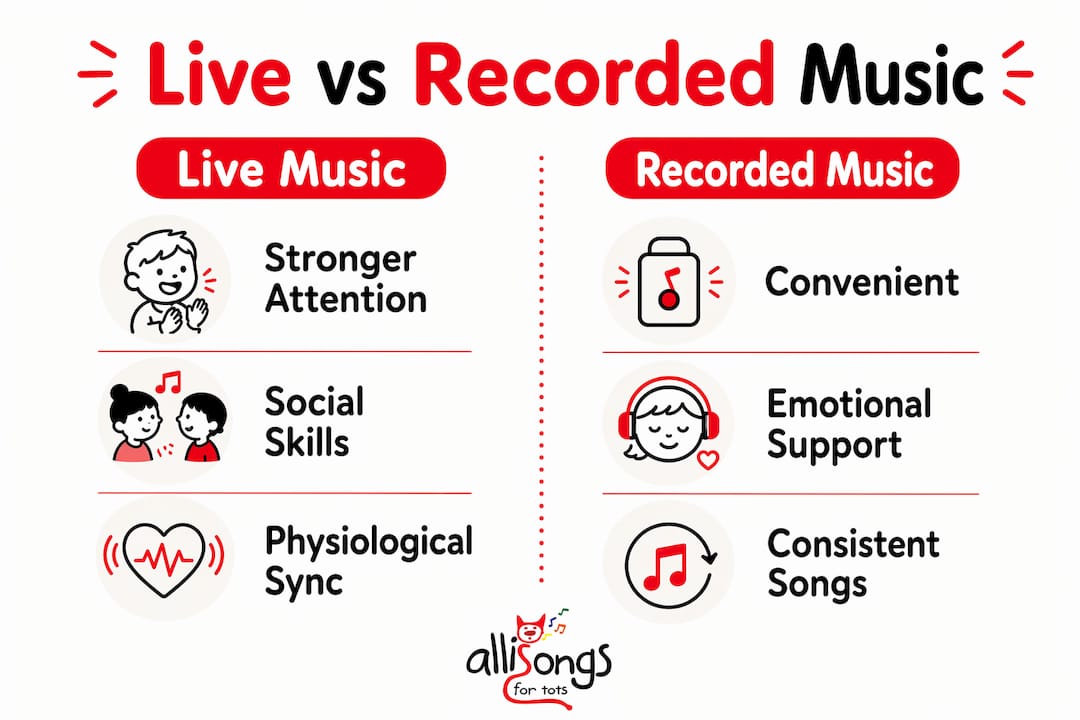
For infants and toddlers, live, participatory music generally supports stronger attention, social coordination, and early communication than recorded music. That said, recorded music still has real value when used with intention. Here is the practical bottom line:
- Prioritize live, participatory classes when your goals are social development, communication, and sustained attention. Research from the TEMPO Lab at the University of Toronto and McMaster’s LIVELab shows infants attend to live music for 72% of a 12-minute show versus 54% for a matched recording.
- Use recorded music deliberately for sleep routines, nap transitions, and reinforcing familiar songs between classes — not as a substitute for group interaction.
- Combine both with caregiver-led singing. Your voice, your timing, and your responsiveness are the most powerful musical tools your child has access to every day.
Pro Tip: Repeating the same two or three songs in a predictable order (a hello song, a play song, a goodbye song) boosts infant engagement more than rotating through varied background playlists. Familiarity is a feature, not a limitation.
Why does live music support infant development so well?
The short answer: live music does things a recording simply cannot. When a performer or caregiver sings directly to an infant, they adjust tempo, pitch, and phrasing in real time to match the baby’s attention. That moment-to-moment responsiveness, called mutual contingency, is one of the key mechanisms behind early learning.
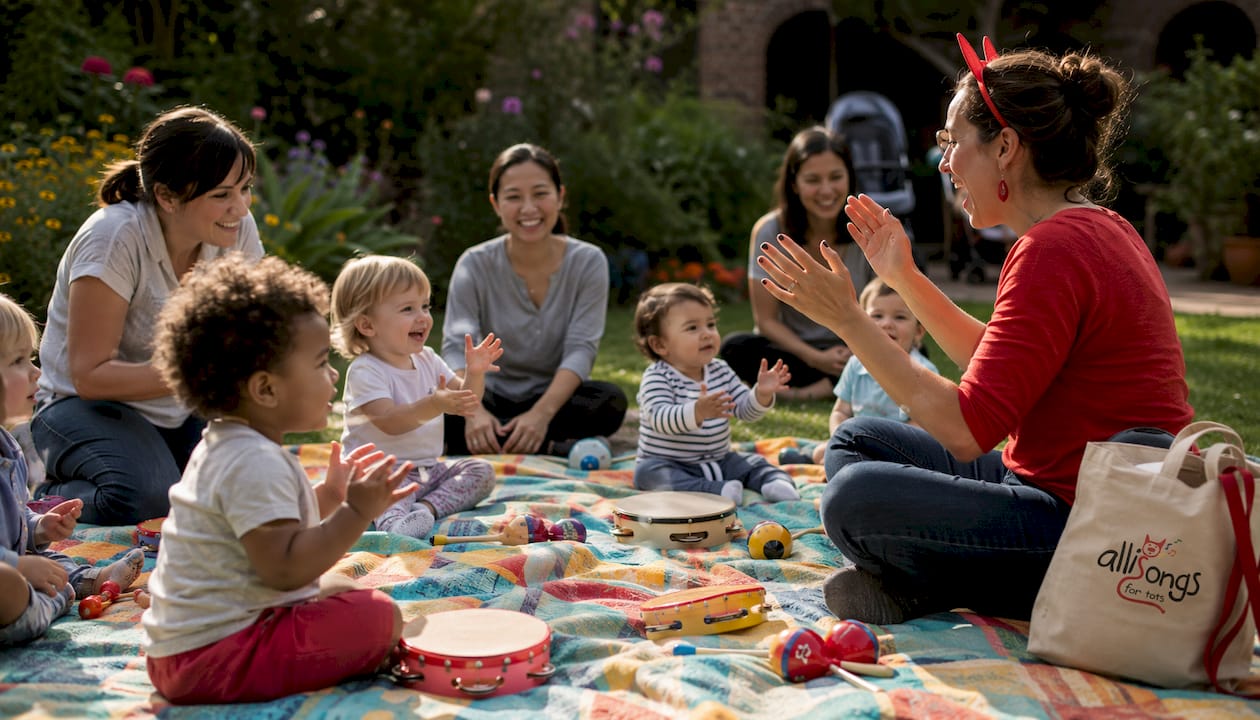
A controlled audience study published in Psychology of Aesthetics, Creativity and the Arts examined 120 infants ages 6–14 months watching a live children’s opera at McMaster University’s concert hall research facility. Infants in the live audience watched 72% of the 12-minute show with sustained attention and showed synchronized heart rates across the group. Infants watching a perceptually matched recording attended only 54% of the time. A separate group watching the recording at home via Zoom averaged about 64% attention, but with shorter, more fragmented bouts and more frequent distractions.
Motor responses also differ. Head movement and physical engagement are measurably stronger when performers and audience members can see and respond to each other, suggesting that live music activates the body, not just the ears.
| Condition | Attention (% of show) | Sustained attention bouts | Heart-rate synchrony |
|---|---|---|---|
| Live audience | 72% | Longer, continuous | Yes |
| Recorded (in-venue) | 54% | Shorter | Not observed |
| Recorded (at home) | ~64% | Shorter, more fragmented | Not observed |
Source: McMaster LIVELab / TEMPO Lab study, 120 infants ages 6–14 months.
A separate study of 6-month-olds found that active musical participation over six months accelerated culture-specific tonality acquisition and improved prelinguistic communication. The social-emotional benefits of live music are well-documented across multiple research lines.
What recorded music actually does for your child
Recorded music is not a lesser option across the board. It serves specific, high-value functions when used with purpose.
Where recorded music works well:
- Sleep and nap routines. A consistent playlist signals the transition to rest and can reduce bedtime resistance over time.
- Background calming. Soft, familiar recordings during feeding or car rides support emotional regulation without requiring active caregiver attention.
- Reinforcing class songs at home. Playing a song your child already knows from a live class deepens familiarity and extends learning.
- Accessibility. For families without nearby classes, a well-structured recorded program with caregiver prompts provides a starting point.
Where recorded music falls short:
- It produces shorter bursts of attention and fewer physiological synchrony effects than live performance.
- It cannot respond to your child’s cues in real time, so the mutual contingency that drives early learning is absent.
- Passive background exposure does not replace the social learning that happens in a group setting.
A simple at-home recorded routine (10 minutes):
- Hello song (familiar, upbeat) — signals music time is starting.
- Play song (moderate tempo) — pair with a simple movement or instrument.
- Calming song (slow, predictable) — signals wind-down.
Using music to support toddler emotional transitions is most effective when the songs are consistent and the caregiver participates actively rather than simply pressing play.
Active engagement vs. passive listening: what actually drives development
Interaction drives learning. Passive listening can capture attention, but the developmental gains in language, social skills, and emotional regulation come primarily from active, caregiver-led musical engagement.
A randomized trial on infant-directed singing found that frequent caregiver singing improved infant mood, and 90.3% of participating parents intended to continue active music-making after the 10-week trial. That is not a small effect. It reflects how quickly families experience the difference between putting on a playlist and actually singing together.
Three active engagement practices you can start today:
- Caregiver-led singing. Sing directly to your child, making eye contact and varying your expression. Even an imperfect voice captures more attention than a polished recording.
- Turn-taking vocal play. Pause mid-phrase and wait for your baby to vocalize back. This back-and-forth builds the conversational timing that underlies early language. For more on supporting these milestones, see this guide on baby language development.
- Movement games. Bounce, clap, or sway in rhythm. Caregiver participation in music classes amplifies the social and physical benefits your child receives.
10–15 minute music moment checklist:
- [ ] Make eye contact during singing
- [ ] Pause and wait for baby’s response before continuing
- [ ] Match your tempo to your child’s energy level
- [ ] Include at least one movement (clapping, bouncing, swaying)
- [ ] End with a consistent calm-down song
Pro Tip: Try matching your singing tempo to your infant’s natural vocalization rhythm rather than a fixed beat. This contingent timing is one of the mechanisms researchers identify as central to early learning.
How do you choose between live classes, recorded programs, and home music time?
Decision rule: Prioritize live, participatory classes when your goals involve social development and communication. Use recorded music for routines and home practice.
Quick decision checklist:
- What is your primary goal? Social skills and communication point toward live classes; soothing and routine support point toward recorded music.
- How old is your child? Infants under 12 months show the strongest preference for live caregiver singing; toddlers 12 months and older also respond enthusiastically to familiar recordings.
- Is caregiver participation built in? A quality class involves you, not just your child.
- What is the class size? Smaller groups (typically under 12 families) allow more contingent interaction.
- What are the teacher’s qualifications? Look for early childhood music education training, not just general music performance.
- How often can you attend? Weekly 30–45 minute sessions are the standard format for infant and toddler programs.
Questions to ask a class provider:
- Are caregivers expected to participate actively, or observe?
- What is the typical group size?
- Are original or culturally diverse songs included?
- What is the volume policy for instruments and amplification?
- Are recorded resources available for home use between sessions?
Allisongs for Tots checks each of these boxes: caregiver participation is built into every session, class sizes are kept small, and the program draws on over 15 years of research-aligned practice. The benefits of group music classes for toddlers go well beyond what any home program can replicate on its own.
What does a high-quality live infant/toddler music class look like?
A well-structured class moves through predictable phases that mirror how infants process new experiences: arrival and warm-up, active engagement, and a calm close.
A typical 30–45 minute session opens with a consistent hello song that signals the start of music time and helps even the youngest babies anticipate what comes next. From there, the group moves into circle songs with caregiver participation, then a movement segment (bouncing, clapping, scarves, or simple props), followed by instrument exploration, and finally a goodbye or lullaby to close.
Age-segmented expectations:
- 0–12 months: Focus on caregiver-led lullabies and playsongs with direct eye contact. Infants at this stage respond most to the caregiver’s face and voice, so your engagement matters as much as the instructor’s.
- 12–24 months: Simple shakers and drums enter the picture, along with call-and-response patterns. Toddlers begin anticipating repeated phrases.
- 24–36 months: Movement sequences, phrasing games, and more complex rhythmic patterns become accessible. Children start initiating songs themselves.
Safety and quality markers to look for:
- Volume kept within safe ranges (research on baby hearing development recommends keeping infant music environments below 85 dB)
- Caregivers seated with infants, not standing apart
- Structured transitions between activities, not open free-play for infants
Red flags: a passive-observer format where caregivers sit back and watch, large unsupervised open-floor sections for infants, or no caregiver involvement at all.
How to combine live classes and recorded music at home
One live class per week is a strong foundation. The real developmental gains come from extending that class into daily home practice.
A sample weekly routine:
- Daily (5–10 minutes): Caregiver-led singing of two or three songs from the current class session. Repetition across the week deepens familiarity.
- Nap/bedtime: A consistent three-song recorded playlist (hello, calm, lullaby) used every time signals the transition to sleep.
- Post-class: Replay one song from class and add a simple movement or instrument to extend the experience.
Keep your home playlist short: 6–8 songs, repeated consistently over several weeks before rotating. Familiar songs generate stronger emotional and attentional responses than constant novelty, especially for children under 12 months.
Pro Tip: Keep recorded music playback below 85 dB in home settings, and avoid screen-only sessions for infants under 18 months. Pair audio playback with your own movement or singing so the experience stays interactive.
Simple extensions of class songs at home: clap the rhythm, add a prop (a scarf, a small drum), or shorten a verse to match your child’s current attention window. These small adaptations keep the song fresh without losing the familiarity that makes it effective.
When live classes aren’t available: what to do instead
Distance, scheduling, mobility, or cost sometimes make regular in-person classes impractical. Strong alternatives exist, but they require intentional selection.
Viable alternatives, in order of developmental value:
- Live online classes with real-time interaction. A video session where the instructor can see and respond to your child preserves some of the contingency that makes live music effective. Look for small group sizes and active caregiver participation.
- Recorded curricula with built-in caregiver instructions. Programs that tell you what to do alongside the music (sing here, pause here, move now) are meaningfully different from passive video content.
- Caregiver peer groups. A small group of families singing together, even informally, creates social context that recorded media cannot.
Vetting criteria for online or recorded programs:
- Does the program include moments of contingent interaction (pauses for response, caregiver prompts)?
- Are segments short (5–10 minutes) and age-appropriate?
- Is there clear guidance for caregivers, not just content for children?
- Is the program grounded in early childhood development research?
For families with sensory needs or mobility constraints, shorter sessions with lower stimulation and clear predictable structure work best. When in-person access becomes possible, even occasional drop-in classes provide the social exposure that home programs cannot fully replicate.
Key Takeaways
Live, participatory music consistently outperforms recorded playback for infant attention, social coordination, and early communicative development, while recorded music serves routines and home practice best when used with caregiver involvement.
| Point | Details |
|---|---|
| Live music wins for attention | Infants attended live performances substantially more than matched recordings in controlled research. |
| Active engagement drives gains | Caregiver-led singing, turn-taking, and movement produce stronger developmental outcomes than passive listening. |
| Recorded music has a clear role | Use consistent playlists for sleep routines, transitions, and reinforcing class songs at home. |
| Class quality markers matter | Look for small groups, caregiver participation requirements, and research-aligned curricula when selecting a program. |
| Allisongs for Tots | Offers research-based, caregiver-participation classes in Tampa for children birth to five, with original songs and age-specific sessions. |
What 15+ years of working with Tampa families has taught us
After more than 15 years of running research-based music classes for infants and toddlers in Tampa, the pattern is consistent: families who attend weekly live sessions and carry two or three songs into their daily home routine see the most meaningful progress. The caregiver-participation model at Allisongs for Tots is not incidental. It is the mechanism. When a parent sings the hello song on Tuesday morning the same way Allison led it on Saturday, the infant’s face lights up with recognition. That recognition is early learning made visible.
A family who joined a mixed-age session with a 9-month-old described a shift they noticed after about six weeks: their baby began vocalizing back during the hello song at home, turning toward the caregiver and holding eye contact through the whole phrase. That kind of prelinguistic turn-taking does not happen from a playlist. It happens because a caregiver learned, in a live class, how to pause and wait.
Allisongs for Tots: research-based live music classes in Tampa
Allisongs for Tots offers in-person, research-based music classes for children from birth through age five at its Tampa location, with sessions designed specifically for babies (0–1), mixed-age groups (birth to five), and older preschoolers (3–7). Every class is built around caregiver participation and features original songs created by director Allison Wilkins alongside culturally diverse repertoire. Families can also explore introductory piano (ages 3.5–6) and sensory art classes.
If you are ready to give your child the social, communicative, and developmental benefits that live music provides, register for a class at Allisongs for Tots. Instrument kits, songbooks, and gift certificates are available online so you can extend the class experience at home from day one.
Useful sources
- McMaster LIVELab / TEMPO Lab infant audience study. Controlled study of 120 infants showing 72% attention for live versus 54% for recorded music, plus heart-rate synchronization in live audiences. Applied to the attention data table and BLUF recommendations. Read the study
- “A concert for babies” (Developmental Science). Behavioral and physiological measures confirming greater engagement in live conditions; source for the mutual contingency mechanism. Read the study
- Randomized trial: infant-directed singing. 10-week trial showing improved infant mood and 90.3% parental intention to continue active music-making. Applied to the active engagement section. Read the trial
- Active musical experience and early development. Study of 6-month-olds showing accelerated tonality acquisition and improved prelinguistic communication after active music participation. Read the study
- Head movement and live vs. recorded audiences. Research showing stronger physical engagement when performers and audiences can see and respond to each other. Read the study
- Neuroscience News summary. Accessible summary of the live vs. recorded attention findings for parent-facing context. Read the summary
- University of Toronto coverage. Describes at-home viewing results (~64% attention, shorter bouts) and the quality-of-attention distinction. Read the coverage
FAQ
Is live music always better than recorded music for babies?
Live, participatory music generally produces stronger attention and social development outcomes, but recorded music is effective for routines, soothing, and home practice when used with caregiver involvement.
How much live music does my infant or toddler need each week?
One weekly 30–45 minute live session, combined with short daily caregiver-led singing at home, is the format most research-aligned programs recommend for children birth to three.
What should I look for in a live infant music class?
Look for small group sizes, required caregiver participation, a structured format with predictable songs, and an instructor with early childhood music education training. Allisongs for Tots builds all of these into every session.
Can recorded music replace a live music class?
Recorded music cannot replicate the mutual contingency, physiological synchrony, or social learning of a live class. It works best as a supplement, not a substitute.
At what age should I start live music classes with my baby?
Classes designed for infants from birth are appropriate from the first weeks of life. Allisongs for Tots offers babies-only sessions starting at birth through 12 months, with mixed-age options continuing through age five.
