


What are the best preschool classroom instruments?
The top instruments for preschool classrooms are percussion-first, safe, and sized for small hands. Educators and music specialists consistently recommend this core set:
- Rhythm sticks (claves): Simple, durable, and perfect for keeping a steady beat. Experts recommend sets of 12 so every child can participate at once.
- Egg shakers: Lightweight, easy to grip, and immediately satisfying for toddlers and preschoolers.
- Hand drums: Encourage both fine and gross motor movement; children can play seated or standing.
- Finger cymbals: Introduce tonal contrast and listening awareness in a gentle, accessible way.
- Chime bars: Support melodic exploration and tonal recognition without requiring prior skill.
Safety, durability, and developmental fit are the three non-negotiable criteria when selecting any of these. Instruments made from natural materials with no small detachable parts are the standard for children under five. Group participation matters too. When every child holds the same instrument, the class can synchronize rhythm together, which builds social cohesion alongside musical awareness.
What types of instruments support preschool development?
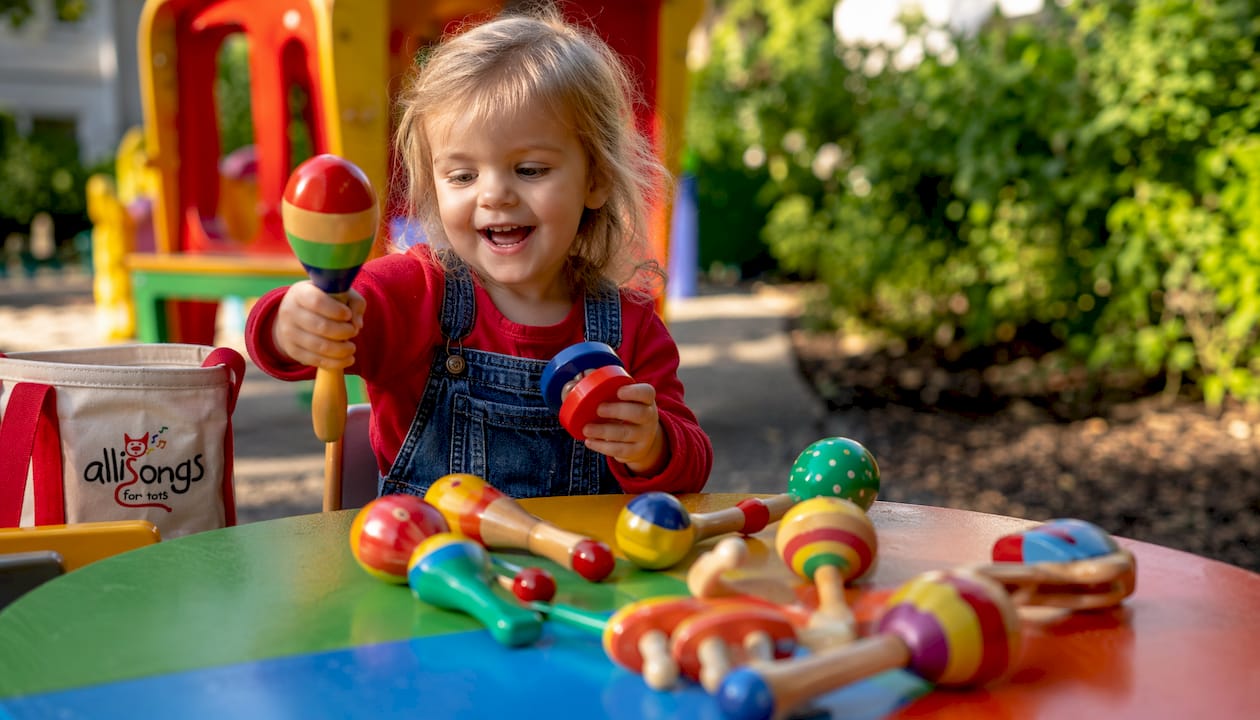
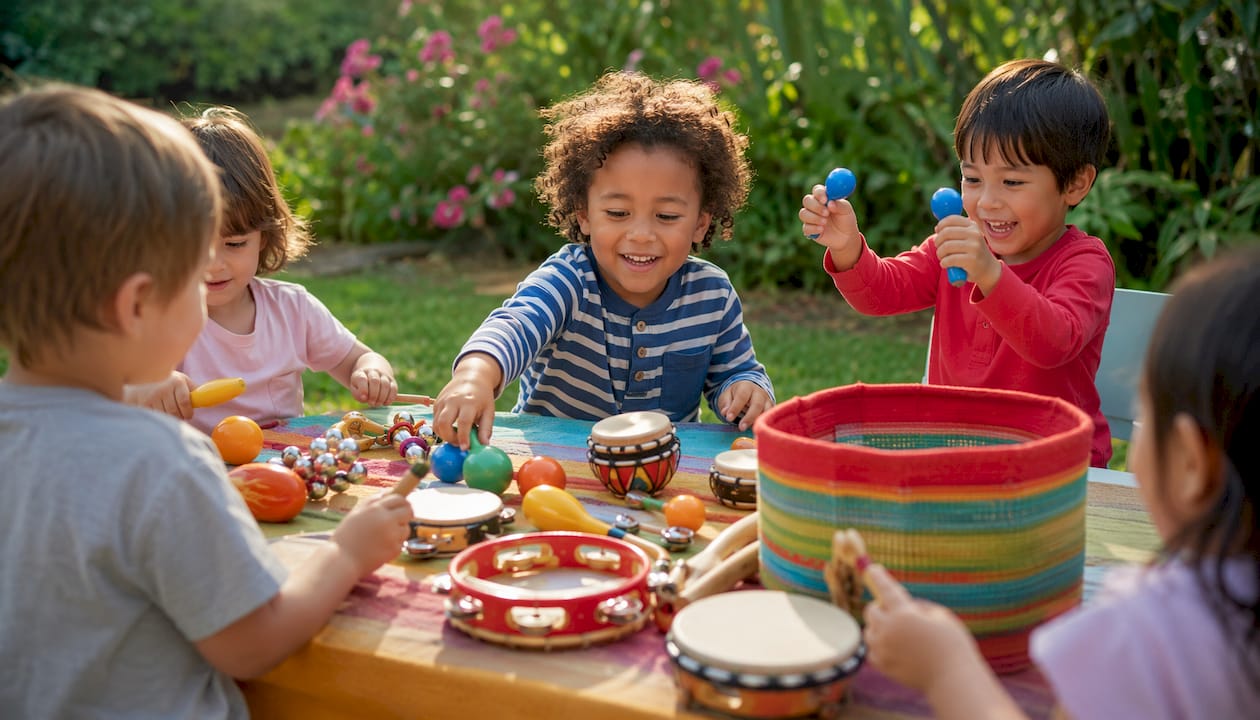
Different instrument families target different developmental skills. Knowing which does what helps you build a classroom set with real purpose.
Percussion instruments are the most accessible starting point. Drums and shakers give children immediate success because there is no “wrong” way to play them at this age. That instant reward keeps engagement high and builds confidence fast. Rhythm work also strengthens fine motor control and lays the neural groundwork for reading readiness, since beat-keeping and language processing share overlapping auditory pathways in the developing brain.
String instruments like beginner violins require more teacher guidance but pay off in fine motor precision and auditory discrimination. They are best introduced as a structured activity rather than free play, and work well in programs where a trained educator leads the session.
Keyboard instruments, including xylophones and simple tone bars, introduce melody and pitch relationships. Children begin to hear that notes have different qualities, which supports tonal awareness and early music literacy.
Wind instruments appropriate for preschoolers, such as simple recorders or slide whistles, build breath control and physical coordination. They work best with children aged four and older who have the lung capacity and focus for directed play.
- Choose instruments that produce a pleasing, accurate sound even when played imprecisely.
- Prioritize natural materials (wood, calf skin) over plastic when budget allows.
- Avoid generic 20-piece mixed sets sold online. They often have poor sound quality and fragile construction that frustrates children rather than engaging them.
Pro Tip: Pick instruments that let every child feel successful in the first 30 seconds. That immediate win is what keeps a preschooler coming back to music, session after session.
Sensory engagement matters too. Instruments that children can touch, tap, and explore through play connect musical learning to the broader sensory development happening at this age.
Florida providers for preschool instruments and music education
Florida educators have strong local options, from instrument retailers to full music education programs. Here is how the key providers compare.
| Provider | Type | Age Suitability | Specialization | Rating |
|---|---|---|---|---|
| Lakeshore Learning Store | Instrument retailer | All preschool ages | Broad classroom supplies, priced at various price points suitable for classroom budgets. | 4.7★ (103 reviews) |
| Fiddlershop | String instrument store | Ages 3+ with teacher | Beginner violins, teacher-recommended beginner violin outfits starting at moderate prices. | 4.9★ (304 reviews) |
| Drummersonly Drum Shop | Percussion retailer | All preschool ages | Quality drums and percussion for classrooms | 4.7★ (73 reviews) |
| School of Rock | Music education | Ages 4+ | Structured group classes, early childhood programs | 4.9★ (105 reviews) |
| Mindful Music Center | Music education | All ages | Mindfulness-integrated music learning | 4.9★ (46 reviews) |
| Allisongs for Tots | Music education + kits | Birth to 5 | Research-based family music classes, instrument kits | 4.9★ (29 reviews) |
| Treasure Grove Music | Music education | Early childhood | Community-focused preschool music programs | 5★ (26 reviews) |
| The Carter Academy | Preschool with music | Ages 3–5 | On-site music as part of daily curriculum | 5★ (18 reviews) |
| The Underwood School | Early learning school | Ages 3–5 | Music-integrated developmental programs | 4.8★ (4 reviews) |
| International School of Music | Music education | All ages | International-style music instruction | 5★ (2 reviews) |
Lakeshore Learning Store is the go-to for educators who need to equip a full classroom on a budget. Its range covers everything from egg shakers to rhythm sets, and the price points make it practical for purchasing in class quantities.
Fiddlershop serves educators and families ready to introduce string instruments. Their teacher-endorsed beginner violin outfits come with free shipping over $35, and the focus on quality construction means instruments hold up through repeated classroom use.
Drummersonly Drum Shop is the right call when percussion is your priority. The shop carries durable options well-suited to the physical demands of preschool play.
For music education programs rather than instrument purchases, School of Rock (Coral Springs) and Mindful Music Center both offer structured early childhood curricula. Mindful Music Center’s integration of emotional well-being into its programs makes it a thoughtful choice for educators who want music and social-emotional development addressed together.
Allisongs for Tots stands apart for families and educators who want a play-based, research-grounded experience for children from birth through age five. The program combines original songs by director Allison Wilkins with culturally diverse music and active caregiver participation, making it the strongest fit for caregivers who want to be part of their child’s musical growth, not just observers. Instrument kits are available for purchase, which extends the classroom experience into the home.
Treasure Grove Music, The Carter Academy, and The Underwood School each serve specific local communities with music-integrated early learning. International School of Music rounds out the list with a specialized music instruction approach for families seeking that style of training.
How do you choose the right instruments for your classroom?
Start with safety, then build from there.
- ASTM F963 compliance: Any instrument sold for children should meet this consumer product safety standard. Look for it on packaging.
- The toilet paper roll test: Any part that fits through a toilet paper roll is a choking hazard for children under three. Apply this test before purchasing any instrument with removable components.
- Non-toxic, BPA-free materials: Preschoolers mouth instruments. Paints, finishes, and materials must be non-toxic with no sharp edges or splinter risk.
- Durability: Classroom instruments take real punishment. Solid wood construction outlasts plastic in both sound quality and longevity.
- Quantity: Buy enough matching instruments for your whole group. Mixed sets where children hold different instruments make synchronization harder and reduce the sense of musical togetherness.
Budget is a real factor. Lakeshore Learning’s range starts at $3.99 per item, which makes building a class set of shakers or rhythm sticks genuinely affordable. Quality hand drums and chime bars cost more, but they last for years with proper care.
For storage, keep instruments in labeled bins at child height so children can access and return them independently. Wipe down non-porous surfaces after each session. Wooden instruments should be stored away from humidity, which is a real consideration in Florida’s climate.
Pro Tip: When introducing a new instrument, let children explore it freely for a few minutes before any structured activity. That unguided play builds curiosity and reduces the urge to misuse the instrument once the lesson begins.
What does research say about music and preschool development?
At Allisongs for Tots, the approach to early music education is grounded in what NAfME describes as developmentally appropriate, child-led musicking. That means creating an environment where children feel safe to experiment, rather than one focused on performance or “getting it right.”
Music supports development across multiple domains simultaneously:
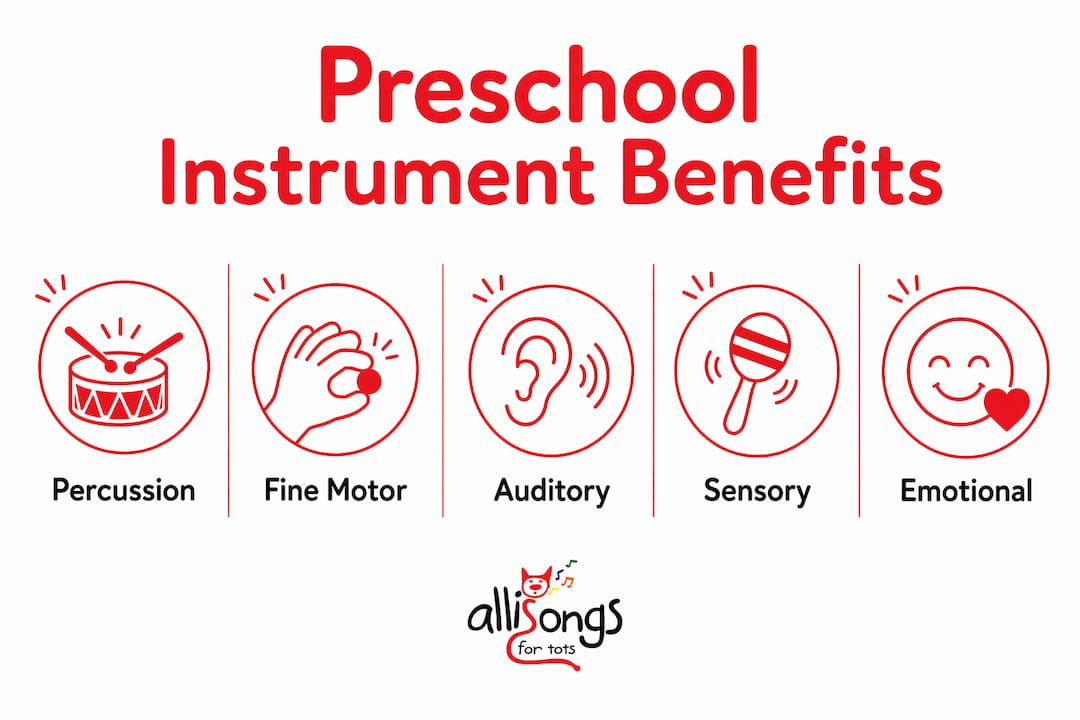
- Speech and language: Music uses the same neural circuits as spoken language. Early rhythm and tonal exposure strengthens the auditory processing children need for reading and communication.
- Motor development: Tapping, shaking, and striking instruments builds both fine and gross motor coordination, supporting the physical milestones children are reaching between ages two and five.
- Social-emotional growth: Group music making creates feelings of belonging and shared experience, which are among the Positive Childhood Experiences linked to healthy long-term development.
- Auditory processing: Listening carefully to pitch, rhythm, and dynamics trains the brain’s ability to distinguish and process sound, a skill that transfers directly to academic learning.
Adult involvement amplifies every one of these benefits. When caregivers participate actively in music sessions rather than watching from the sidelines, children’s engagement deepens and their sense of safety in the musical environment grows. That is why Allisongs for Tots builds caregiver participation into every class structure, not as an optional add-on, but as a core part of the learning design.
The goal is not to produce musicians at age four. It is to give children rich, joyful musical experiences during the years when their brains are most receptive to that kind of input.
Allisongs for Tots brings music education to Tampa families
If you are looking for a program that puts research-based music learning and caregiver connection at the center, Allisongs for Tots offers something the instrument retailers and general music schools on this list do not.
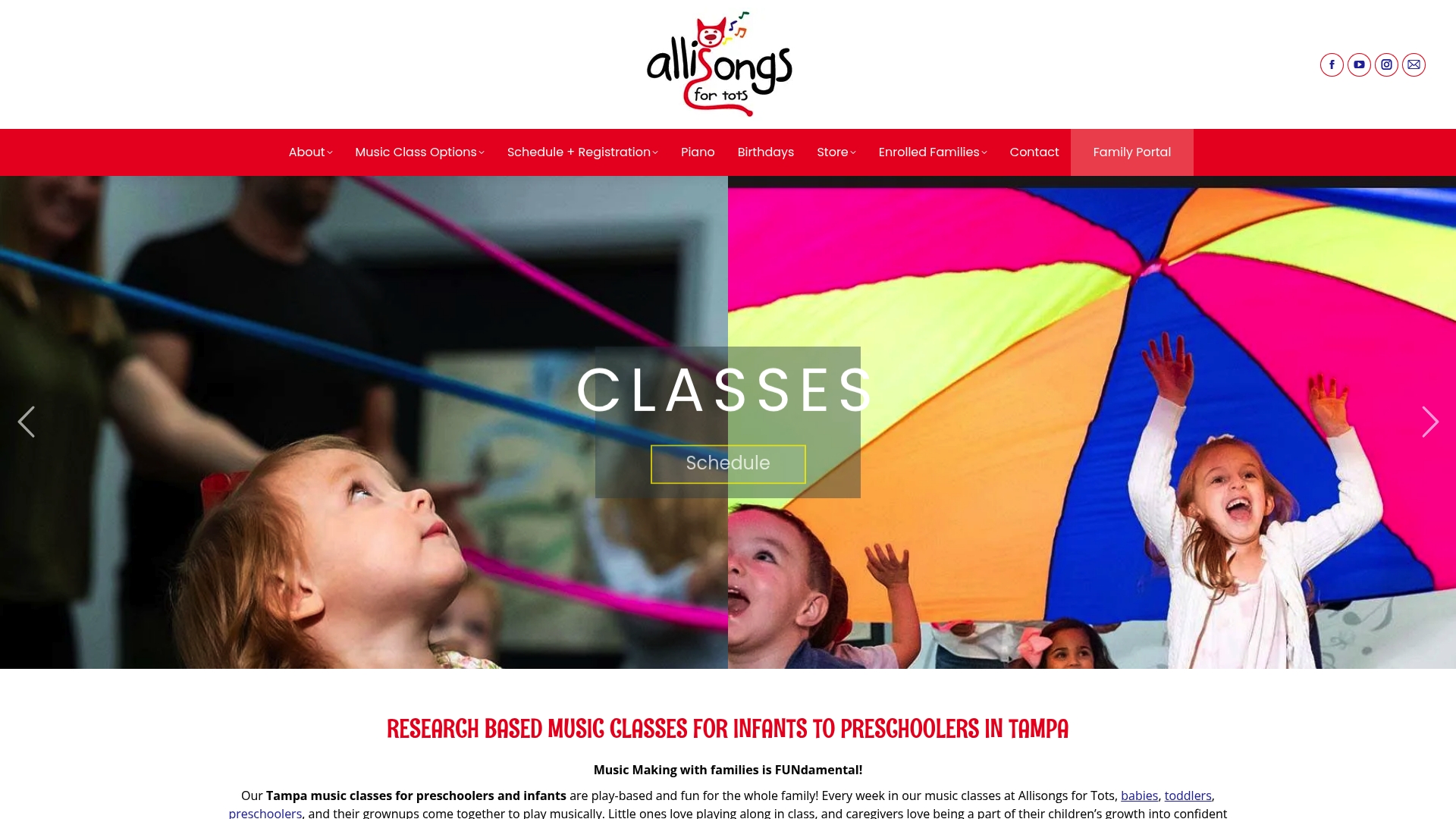
Classes run for children from birth through age five, with sessions designed around family participation, culturally diverse music, and original songs created by director Allison Wilkins. Instrument kits are available to purchase so the music continues at home between sessions. For caregivers who want to understand their child’s musical development milestones and be genuinely involved in building them, this is the program built for that. Learn more and register at Allisongs for Tots.
Key Takeaways
Percussion instruments are the most developmentally accessible starting point for preschool classrooms, and buying matching sets of 12 ensures every child can participate in group rhythm activities from day one.
| Point | Details |
|---|---|
| Start with percussion | Drums, shakers, and rhythm sticks give children immediate success and support rhythm and motor development. |
| Buy matching sets | Sets of 12 matching instruments let children synchronize rhythm together, building musical and social skills. |
| Safety first | Look for ASTM F963 compliance, non-toxic materials, and apply the toilet paper roll test for any removable parts. |
| Choose quality over quantity | Avoid generic mixed sets; natural materials and solid construction produce better sound and last longer in classrooms. |
| Allisongs for Tots | Offers research-based family music classes and instrument kits for children birth to five in Tampa, Florida. |
FAQ
What are the best instruments for preschoolers?
Rhythm sticks, egg shakers, hand drums, finger cymbals, and chime bars are the top recommended instruments for preschool classrooms. They are safe, immediately engaging, and support rhythm, motor, and tonal development without requiring prior skill.
What is a good instrument for a 4-year-old to learn?
Hand drums and simple xylophones work well for four-year-olds because they reward exploration immediately. At this age, a beginner violin with teacher guidance is also a strong option for developing fine motor skills and auditory discrimination.
What is the best instrument for a child with ADHD?
Percussion instruments, especially hand drums and rhythm sticks, tend to work well for children with ADHD because they channel physical energy into purposeful movement. The immediate sensory feedback of striking or shaking an instrument supports focus and engagement in a way that more passive activities often do not.
What are the top 5 most popular instruments for preschool classrooms?
The most widely used classroom rhythm instruments for preschoolers include rhythm sticks, egg shakers, hand drums, finger cymbals, and chime bars. These appear consistently in teacher recommendations and early childhood music education guidelines across the United States.
Recommended
- Music Classes for Preschoolers & Infants in Tampa | 941-350-5438 | Allisongs for Tots
- Top 5 Fun Music Activities for Babies and Toddlers in Tampa | Early Childhood Development
- 5 Signs Your Child is Ready for Their First Music Class | Music Education Tips
- The Role of Parents in Tampa Infant Music Classes: Support Your Child’s Musical Journey – Allisong for Tots