


TL;DR:
- Consistent and simple circle time songs help preschoolers develop routines, focus, and social skills. Repeating core songs over several weeks builds confidence, mastery, and engagement in early learning. Movement and culturally diverse songs support cognitive, motor, and emotional development effectively.
Circle time songs are defined as structured musical activities used at the start of a preschool session to build routine, focus attention, and support early development. The best circle time songs follow a clear functional order: hello, calendar, weather, movement, learning, and goodbye. This structure is not a preference. Research confirms that predictable song order reduces classroom disruptions and keeps preschoolers engaged from the first note to the last. At Allisongs for Tots, we have seen this play out in Tampa classrooms and living rooms for over 15 years.
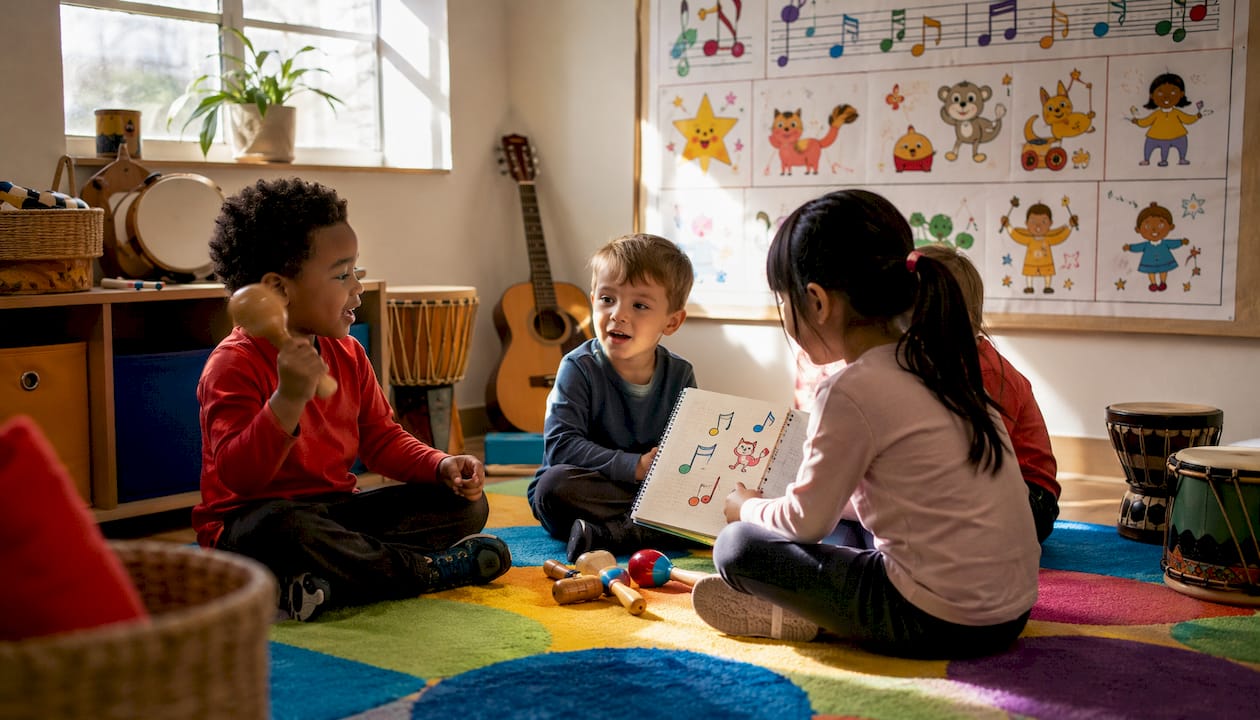
What are the best circle time songs and why structure matters
The best circle time songs are not just catchy tunes. Each song serves a specific role in the session, and that role determines which song belongs there. The “one song per function” approach means you assign a single, consistent song to each part of the routine: one hello song, one calendar song, one goodbye song. Children learn what comes next because the music tells them.
Consistent song order produces smoother sessions and fewer behavioral interruptions. Predictability gives young children a sense of safety, which frees up their attention for learning. When a toddler hears the same hello song every morning, their brain shifts into “ready to participate” mode before you sing the second line.
Attention span also shapes your song choices. Best practices recommend these time slots for ages 3–5:
- Hello: 0–2 minutes
- Movement or calm: 2–8 minutes
- Learning activity: 8–14 minutes
- Fingerplay: 14–18 minutes
- Goodbye: 18–20 minutes
For ages 2–3, shorter sessions of 15–20 minutes work best. Children in this age range simply cannot sustain focus beyond that window, so every song must earn its place.
Pro Tip: Print a simple song order card and post it at eye level for the children. Visual cues reinforce the auditory routine and help children with different learning styles follow along.
1. “The More We Get Together” (hello song)
“The More We Get Together” is the gold standard hello song for circle time. Its melody is simple, its lyrics are warm, and it names the group as a community from the first verse. Children feel seen and welcomed before the session even begins. The song’s slow, steady tempo also helps settle any lingering energy from the transition into the room.
From a developmental standpoint, hello songs build joint attention. Every child focuses on the same moment at the same time, which is a foundational social skill. Music creates a playful pathway to social-emotional growth that direct instruction simply cannot replicate at this age.
2. “Days of the Week” (calendar song)
A calendar song anchors children in time and sequence. “Days of the Week” set to a familiar tune (many educators use the melody of “The Addams Family”) gives children a rhythmic framework for understanding the week. Repetition of the days in order builds working memory and sequencing skills.
Calendar songs also give educators a natural moment to introduce concepts like yesterday, today, and tomorrow. These abstract time words become concrete when paired with a predictable melody children already know. The song does the cognitive heavy lifting.
3. “The Weather Song” (weather observation)
Weather songs teach children to observe their environment and name what they see. A simple call-and-response format works best: the educator asks about the weather, and the children respond with the matching verse. This format builds vocabulary and encourages active participation rather than passive listening.
In Florida, weather observation is especially relevant. Tampa’s mix of sunshine, afternoon thunderstorms, and humid mornings gives children real, daily material to work with. A weather song that includes options for “sunny,” “rainy,” and “cloudy” covers most of what Florida preschoolers will actually experience.
4. “If You’re Happy and You Know It” (movement song)
“If You’re Happy and You Know It” is one of the most effective movement songs for circle time because it links emotion to physical action. Children clap, stomp, and shout in direct response to the lyrics. This connection between feeling and movement supports emotional regulation and body awareness simultaneously.
The song also scales easily. You can add verses for different emotions or actions, keeping it fresh without changing the structure. That flexibility makes it a reliable tool for educators who need to adjust energy levels mid-session.
Pro Tip: Use “If You’re Happy and You Know It” as a reset song when the group’s energy spikes unexpectedly. The structured actions give children a physical outlet that brings them back to focus within 60 seconds.
5. “Open Shut Them” (fingerplay and fine motor)
Fingerplay songs like “Open Shut Them” develop fine motor skills and hand-eye coordination through guided movement. Children open and close their hands, tap fingers together, and follow a sequence of gestures tied to the lyrics. This type of activity directly supports the hand strength needed for writing.
Songs with clear, simple lyrics and regular rhythm maximize language learning benefits. “Open Shut Them” checks both boxes. Its lyrics are short, its rhythm is steady, and the physical component reinforces word meaning in a way that listening alone cannot.
6. “Head, Shoulders, Knees and Toes” (body awareness)
“Head, Shoulders, Knees and Toes” teaches body part vocabulary through movement and repetition. The song speeds up with each verse, which adds a playful challenge and keeps children engaged. Faster tempos also build processing speed and coordination as children try to keep up.
This song works well as a transition between a calm learning activity and a higher-energy movement segment. It raises the group’s energy gradually rather than abruptly, which helps prevent overstimulation.
7. “The Wheels on the Bus” (language and imagination)
“The Wheels on the Bus” is a top circle time song for language development because it uses repetitive sentence structures and action verbs. Children fill in the blanks, predict the next verse, and act out the motions. Each of these behaviors builds language and literacy skills in a low-pressure, joyful context.
The song also invites creativity. Educators can substitute new characters or sounds, turning a familiar tune into an open-ended language activity. That adaptability makes it a staple across age groups from infants to kindergarteners.
8. A cleanup transition song (routine management)
A dedicated cleanup song signals the end of one activity and the start of another without raising your voice. Transition songs help children anticipate changes, which improves routine flow and emotional regulation. Children who know a song means “cleanup time” respond faster and with less resistance than children who hear a verbal command.
Any simple, repetitive melody works here. The key is consistency. Use the same song every single time, and children will begin tidying up before you finish the first line.
9. A Latin rhythm song (cognitive development)
Including at least one Latin rhythm song in your circle time rotation delivers measurable cognitive benefits. 8-week music programs using Latin music genres showed enhanced rhythmic skills and executive functions in children ages 2–4. Executive functions include inhibitory control and working memory, two skills that predict school readiness.
Allisongs for Tots incorporates culturally diverse music, including Latin rhythms, into its Tampa classes for exactly this reason. Songs like “La Bamba” adapted for young children or original compositions with Latin percussion give preschoolers a cognitive workout wrapped in a joyful musical experience.
10. “Skinnamarink” (goodbye song)
“Skinnamarink” is the ideal goodbye song because its message is affectionate and its melody is calm. It signals the end of circle time with warmth rather than abruptness, helping children transition out of the group experience with positive feelings intact. A consistent goodbye song also gives children a clear endpoint, which reduces anxiety about the session ending.
Goodbye songs reinforce the relational core of circle time. Eye contact and steady rhythms are the primary goals of circle time music, more than curriculum delivery. A gentle goodbye song honors that priority.
How to incorporate movement songs without overstimulation
High-energy movement songs are powerful tools, but timing determines whether they help or hurt. Limit movement songs to 2–5 minutes per session to prevent overstimulation. Place them after a calm learning activity, not at the very start of circle time when children are still settling.
Pacing matters as much as song choice. A good sequence moves from calm (hello) to moderate energy (calendar, weather) to active (movement) and back to calm (fingerplay, goodbye). This arc mirrors the natural attention curve of a preschooler and keeps the group regulated throughout.
For Florida educators and parents, rhythm activities also support motor skill development in ways that connect directly to physical education goals. Combining music and movement is not just fun. It is developmentally purposeful.
- Keep high-energy songs to one per session for ages 2–3
- Follow every active song with a slower, quieter one
- Use egg shakers or wrist bells to add rhythm without increasing volume
- Watch for signs of overstimulation: covering ears, withdrawing, or becoming disruptive
Tips for sustaining engagement over time
Keeping 5 core songs for 3–4 weeks instead of frequently rotating builds mastery and a sense of safety. Children who know a song well enough to sing along independently show greater confidence and participation. Rotating songs too quickly robs them of that experience.
Your voice matters more than your performance. A calm, steady voice with eye contact engages preschoolers more effectively than high-energy theatrics. Children prioritize relational connection. They want to feel seen by you, not dazzled by you.
Preparation also determines consistency. Organized songs and instruments kept in a dedicated spot make it easy to run circle time every day without scrambling. Egg shakers, wrist bells, and small hand drums cover most rhythmic needs and support fine motor development at the same time.
Pro Tip: Print a simple song sheet with lyrics and laminate it. Keep it in your circle time basket. On days when your memory fails or a substitute steps in, the routine stays intact.
Supporting baby language milestones through song is most effective when the same songs appear consistently across home and classroom settings. When parents know the circle time songs their child hears at school, they can reinforce them at home, doubling the exposure.
Key Takeaways
The most effective circle time music routine assigns one consistent song to each functional role and repeats that core set for 3–4 weeks to build mastery, confidence, and engagement.
| Point | Details |
|---|---|
| Use one song per function | Assign a single song to hello, calendar, movement, and goodbye for predictable structure. |
| Limit movement songs to 2–5 minutes | High-energy songs beyond this window risk overstimulation in children ages 2–5. |
| Repeat core songs for 3–4 weeks | Repetition builds mastery and gives children the confidence to participate fully. |
| Prioritize voice and eye contact | A calm, steady voice with eye contact engages preschoolers more than energetic performance. |
| Include culturally diverse rhythms | Latin music genres show particularly strong benefits for executive function development. |
What 15 years of circle time taught me about song selection
After more than 15 years leading music classes for infants and preschoolers in Tampa, the lesson that surprises most parents is this: simpler is almost always better. Educators often feel pressure to keep things fresh and exciting, so they rotate songs weekly. The children, however, do not want novelty. They want to know what comes next.
The moment a child sings along without prompting, something shifts. Their posture changes. Their eyes light up. That is not just enjoyment. That is confidence taking root. A limited song rotation creates that moment far faster than a constantly changing playlist ever could.
Balancing educational goals with genuine fun is not a tension you have to resolve. The right songs do both at once. “Open Shut Them” builds fine motor skills while making children giggle. “Skinnamarink” closes the session with warmth while reinforcing the relational bond that makes learning possible. The educational benefit is built into the joy, not added on top of it.
The hardest part of running circle time well is not finding the right songs. It is trusting the routine enough to repeat it, day after day, even when it feels repetitive to you. Your children are not bored. They are learning.
— Allisongs for Tots
Music classes that bring circle time to life
Circle time songs work best when children experience them in a structured, social setting with a skilled music educator guiding the room.
Allisongs for Tots offers music classes for preschoolers and infants in Tampa, designed around the same research-backed principles covered in this article. Director Allison Wilkins brings over 15 years of experience and a repertoire of original and culturally diverse songs to every session. Classes emphasize adult involvement, so caregivers participate alongside their children and reinforce the routine at home. If you want your child to experience the full developmental benefits of structured circle time music, Allisongs for Tots is the place to start.
FAQ
What makes a circle time song effective for preschoolers?
An effective circle time song has a simple, repetitive melody, clear lyrics, and a defined function within the session’s routine. Predictability and consistency matter more than novelty.
How long should circle time music last?
Circle time sessions should last 15–20 minutes for ages 2–3 and 20–30 minutes for ages 3–5, with movement songs limited to 2–5 minutes to prevent overstimulation.
How often should I change circle time songs?
Keep a core set of 5 songs for 3–4 weeks before rotating. Frequent changes prevent children from reaching the mastery and confidence that come with repetition.
Do movement songs help with learning or just burn energy?
Movement songs support cognitive development, emotional regulation, and motor skills simultaneously. Latin rhythm songs in particular show measurable gains in executive function in children ages 2–4.
Can the same songs work at home and in the classroom?
Yes. Using the same songs in both settings doubles a child’s exposure and reinforces the routine across environments, which strengthens language development and emotional security.
