


TL;DR:
- Toddlers can learn to keep a beat through short, movement-based activities with caregiver involvement. Such activities stimulate brain regions linked to attention, language, and motor skills development. Structured classes that promote social synchronization and consistent practice accelerate progress and early rhythm mastery.
Yes — toddlers can absolutely learn to keep a beat, and the research is clear that short, social, movement-rich activities are the most effective way to get there. You do not need expensive instruments or a music degree. Here is what to try right now:
- March together for 30 seconds to a favorite song, stepping on every beat.
- Tap a steady pulse on a pot with a wooden spoon while you chant a simple rhyme.
- Play “freeze” — stop the music suddenly and hold still, then start again.
Caregiver involvement is the single biggest factor in how quickly a toddler develops rhythm skills. When you model the beat, your child has a human partner to synchronize with, which research shows produces better results than any recording alone. The sections below cover age expectations, specific activities, what a good class looks like, and how to choose one in the Tampa area.
Why beat-keeping helps toddlers far beyond music class
Learning to keep a steady beat does more than prepare a child for a drum kit someday. Intentional music activities light up brain areas tied to attention, memory, and language development in very young children, according to neuroscientists at the Royal Conservatory of Music. Beat-based rhythm processing also strengthens the predictive skills that underlie early reading, because recognizing a recurring pulse trains the same neural pathways that later help children anticipate phonetic patterns in speech.
Motor development gets a boost too. Marching, swaying, and freeze games develop the vestibular and proprioceptive systems, which are foundational for motor skills like writing and climbing. A clustered randomized controlled trial of the RAMSR program found that classroom rhythm activities significantly improved self-regulation and executive function in preschool children in disadvantaged communities.
The connection to language is equally compelling. Rhythm and early language development share overlapping predictive processes in the brain, which is one reason children who engage regularly with beat-based activities often show stronger pre-reading skills.
What to expect at each age: a realistic beat-keeping timeline
Every child develops at their own pace, but these age bands give you a reliable map of what is typical.
| Age | What you will typically see |
|---|---|
| 6–11 months | Spontaneous bouncing, swaying, or limb movements in response to music; no intentional synchronization yet |
| 12–23 months | More deliberate rhythmic movement; begins to bang objects in a repetitive pattern; tempo is self-driven |
| 24–30 months | Flexible tempo adjustment begins to emerge; child starts to slow or speed drumming toward a partner’s pace |
| 30 months | Accurate synchronization with a human partner becomes more consistent; social entrainment is visible |
| 3+ years | Can follow a steady external beat, copy rhythmic patterns, and participate in structured call-and-response |
A child’s spontaneous motor tempo naturally slows with age, and training works best when it respects that natural pace rather than pushing a toddler toward an adult tempo. If your child shows no response to music, no rhythmic movement by 18 months, or significant delays across multiple developmental areas, a conversation with your pediatrician or an early intervention specialist is a reasonable next step. For a deeper look at musical milestones from 0–3 years, Allisongs for Tots has a detailed resource worth bookmarking.
Practical activities that teach toddlers to keep a steady beat
The core principle: start with whole-body movement, then move to hands, then instruments. Short and predictable beats work better than complex rhythms, and your modeling matters more than any toy.
Activity list (home and class-friendly):
- Marching: Walk in place or around the room, stepping on every beat of a song. Start at a moderate tempo close to your child’s natural walking pace.
- Lap patting: Sit face-to-face and pat your knees together on the beat. This skin-to-skin contact adds a tactile layer that recordings cannot replicate.
- Pot drumming: Household items like pots and wooden spoons provide varied tactile and auditory feedback that supports sound discrimination and timing.
- Call-and-response clapping: Clap a short pattern and invite your child to echo it back. Keep patterns to two or three beats at first.
- Freeze game: Play music and stop it suddenly. Holding still on the pause builds inhibitory control alongside rhythm awareness.
- Shaker songs: Fill a sealed plastic bottle with rice. Shake on every beat while singing a familiar song.
Simple progression for each activity:
- Begin with full-body movement (marching, swaying).
- Add hands once the body is engaged (clapping, lap patting).
- Introduce a simple instrument (shaker, pot) after hands are steady.
- Gradually slow the tempo to stretch synchronization ability.
Pro Tip: Keep your tempo close to your child’s spontaneous walking pace, roughly 100–120 beats per minute for most toddlers. Pushing too fast or too slow makes synchronization harder, not easier.
Safety notes: Use instruments sized for small hands. Keep volume at conversational levels. Watch for signs of overstimulation — turning away, covering ears, or becoming fussy — and shorten the session if they appear. Sessions of 5–10 minutes are plenty for children under two.
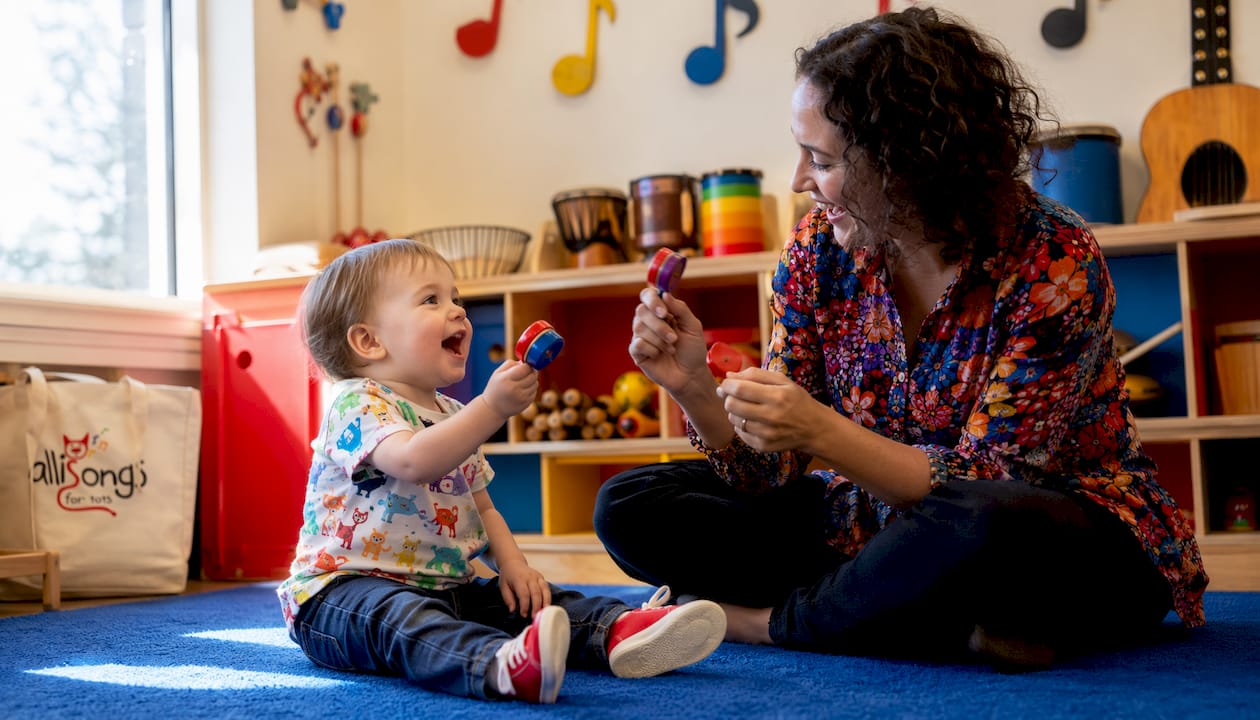
How a well-run toddler music class is structured
A good session follows a predictable arc that toddlers can anticipate, which lowers anxiety and frees up attention for learning. Here is what a typical 45-minute class looks like:
| Segment | Duration | Purpose |
|---|---|---|
| Hello song | 3–5 min | Signals the start; names each child to build belonging |
| Movement songs | 10 min | Marching, swaying, freeze games for motor and beat work |
| Instrument exploration | 5–10 min | Free and guided play with shakers, drums, rhythm sticks |
| Slow lap song or story | 5–7 min | Caregiver holds child; quiet bonding and pulse internalization |
| Parachute or bubbles | 5 min | Shared sensory experience; cooperative play |
| Goodbye song | 3–5 min | Predictable close; reinforces routine |
Caregiver participation is not optional in a quality program. When you sing, clap, and move alongside your child, you become the human partner that social synchronization research consistently shows produces better beat alignment than any recording. Red flags to watch for: a teacher who discourages caregiver involvement, sessions longer than 45–50 minutes for toddlers, or no structured role for the adult in the room.
Pro Tip: Ask the teacher to demonstrate one or two songs at the end of class that you can practice at home. Repetition across settings accelerates learning faster than class time alone.
For more on why group settings amplify these gains, see why group music classes outperform private lessons for toddlers.
How often to practice and what progress looks like
Short and frequent beats long and occasional. Aim for 5–10 minutes daily, or 15–20 minutes two to three times per week, built into an existing routine like bath time or after lunch. Brief, predictable micro-sessions are more effective for toddlers than longer, infrequent ones because toddler attention windows are short and consistency builds neural pathways faster than volume.
Progress milestones to watch for:
- Engages with a steady pulse (bounces, sways, or taps along).
- Copies a caregiver’s tap or clap pattern.
- Attempts to slow or stop on cue during freeze games.
- Synchronizes with a human partner for several beats in a row.
Troubleshooting common problems:
- Child ignores the beat: Try a slower tempo and more whole-body movement before adding hands or instruments.
- Overstimulation: Shorten the session and reduce instrument volume.
- Frustration: Drop the structure and make it a free-play dance session. Come back to guided activities the next day.
- No visible progress after several weeks: Consult your pediatrician or an early intervention specialist, especially if other developmental milestones are also delayed.
Most families notice visible gains within a few weeks of consistent practice. Social joint-drumming with a caregiver or peers tends to accelerate synchronization noticeably.
What to look for when choosing a toddler music class
| Criteria | What a quality program offers |
|---|---|
| Live music | Teacher plays or sings live; not reliant solely on recordings |
| Caregiver participation | Adults are expected and welcomed as active partners |
| Group size | Small enough for individual attention (typically 6–11 families) |
| Session length | 30–45 minutes for mixed-age; shorter for babies-only groups |
| Teacher training | Background in early childhood music education or equivalent |
| Repertoire | Age-appropriate, culturally diverse, includes original songs |
| Pacing | Follows the child’s energy; not rigidly scripted |
A Montessori music-movement study found that live piano accompaniment produced more significant gains in rhythmic ability than recorded music alone, reinforcing the value of a live teacher over a playlist. When you call a studio, ask: “Do caregivers participate actively?” and “How do you handle a child who needs a slower tempo?” The answers tell you a lot about the program’s philosophy. Local class tuition in Tampa varies; most studios offer a trial class or observation session before you commit to a full session.
Key Takeaways
Toddlers develop steady beat skills fastest through short, caregiver-led, movement-based activities practiced consistently, with social synchronization accelerating progress beyond what recordings alone can achieve.
| Point | Details |
|---|---|
| Start with movement | Whole-body activities like marching and swaying build the foundation before hands or instruments are introduced. |
| Keep sessions short | Five to ten minutes daily outperforms longer, infrequent practice for toddlers. |
| Caregiver presence matters | Children synchronize more accurately with a human partner than with a recording. |
| Expect milestones gradually | Flexible tempo adjustment typically emerges around 24–30 months; accurate synchronization by 30 months. |
| Allisongs for Tots | Tampa’s research-based program for children birth to five combines live music, caregiver participation, and culturally diverse repertoire in structured 30–45 minute sessions. |
What we see working in class after 15 years
After more than 15 years of teaching music to infants and toddlers in Tampa, the pattern that stands out most clearly is this: the children who make the fastest gains are the ones whose caregivers are fully in the room, not watching from the sidelines. When a parent sings the hello song with genuine enthusiasm, their child locks in. When a caregiver taps the beat on their own knees during instrument time, the toddler mirrors it within seconds. That is social synchronization in action, and no app or recording can replicate it.
At Allisongs for Tots, every session is built around that principle. Director Allison Wilkins developed an original song repertoire alongside a multicultural library specifically because children respond differently to varied tonal and rhythmic patterns. A child who seems disengaged during one song will often light up during another. Variety is not just enrichment; it is a diagnostic tool.
Parents sometimes worry that their child is “behind” because synchronization looks messy at 18 months. It is supposed to. The research on spontaneous motor tempo confirms that accurate synchronization is a 30-month milestone for most children, not an 18-month one. Trust the process, stay in the room, and keep it playful.
Allisongs for Tots: music classes for Tampa families
If you are ready to take the home practice into a structured, live-music setting, Allisongs for Tots offers in-person music classes in Tampa for children from birth through age five. Sessions include mixed-age groups, babies-only classes, master classes for ages 3–7, and introductory piano for ages 3.5–6. Every class is built around caregiver participation, original songs, and a culturally diverse repertoire grounded in 15+ years of early childhood music research.
Instrument kits, songbooks, and gift certificates are available for purchase online, so you can extend the learning at home between sessions. Special events and birthday parties are also on the calendar. Visit allisongsfortots.com or call 941-350-5438 to check the current schedule, ask about a trial class, or register for an upcoming session.
Research and resources to read next
- Read: “As tiny tots sing, tap and play in music class, experts say it boosts their brain development” — CBC News — Royal Conservatory neuroscientist findings on attention, memory, and language.
- Read: “Music Class Benefits for Toddlers: A Research Guide” — Happy Day Play Family Learning — practical session structure and caregiver guidance.
- Read: “Joint drumming: Social context facilitates synchronization in preschool children” — Kirschner & Tomasello, 2009 — the foundational study on social vs. mechanical synchronization.
- Read: “Rhythm and movement delivered by teachers supports self-regulation” — ScienceDirect / RAMSR trial — RCT evidence for classroom rhythm programs and executive function.
- Read: “Moving to the beat” — QUT ePrints review — comprehensive review of beat synchronization and self-regulation in early childhood.
- Read: “Keeping a Beat” — Kentucky Early Childhood Family Guide — household instrument ideas for home practice.
FAQ
At what age can toddlers start keeping a beat?
Spontaneous rhythmic movement appears in infants as young as six months, but flexible tempo adjustment and accurate synchronization with a partner typically emerge between 24 and 30 months.
Does my child need musical instruments to practice?
No. Pots, wooden spoons, and sealed bottles filled with rice are pedagogically effective because they provide varied tactile and auditory feedback that supports timing and sound discrimination.
How long should a beat-keeping practice session be?
Five to ten minutes daily is more effective for toddlers than longer, infrequent sessions. Short, predictable routines built into the day produce faster gains.
Why does my toddler synchronize better when I drum with them?
Research from a 2009 joint-drumming study found that children synchronize more accurately with a human partner than with a machine or recording, because social cues add a layer of predictive information that audio alone cannot provide.
What should I look for in a toddler music class in Tampa?
Look for live music, active caregiver participation, small group sizes, sessions of 30–45 minutes, and a culturally diverse repertoire. Allisongs for Tots in Tampa offers all of these in structured classes for children from birth through age five.